

Environmental Management
NSK’s Approach
Addressing environmental issues, such as the increasingly serious advance of climate change worldwide, and building a sustainable world where economic growth and protection of the global environment are both possible are challenges facing all of humanity. The NSK Group’s Mission Statement declares that NSK “helps protect the global environment.” With the environment as one of our core values, we carry out environmental activities to address global issues, contribute to the realization of a sustainable society, and improve our corporate value.
Policy
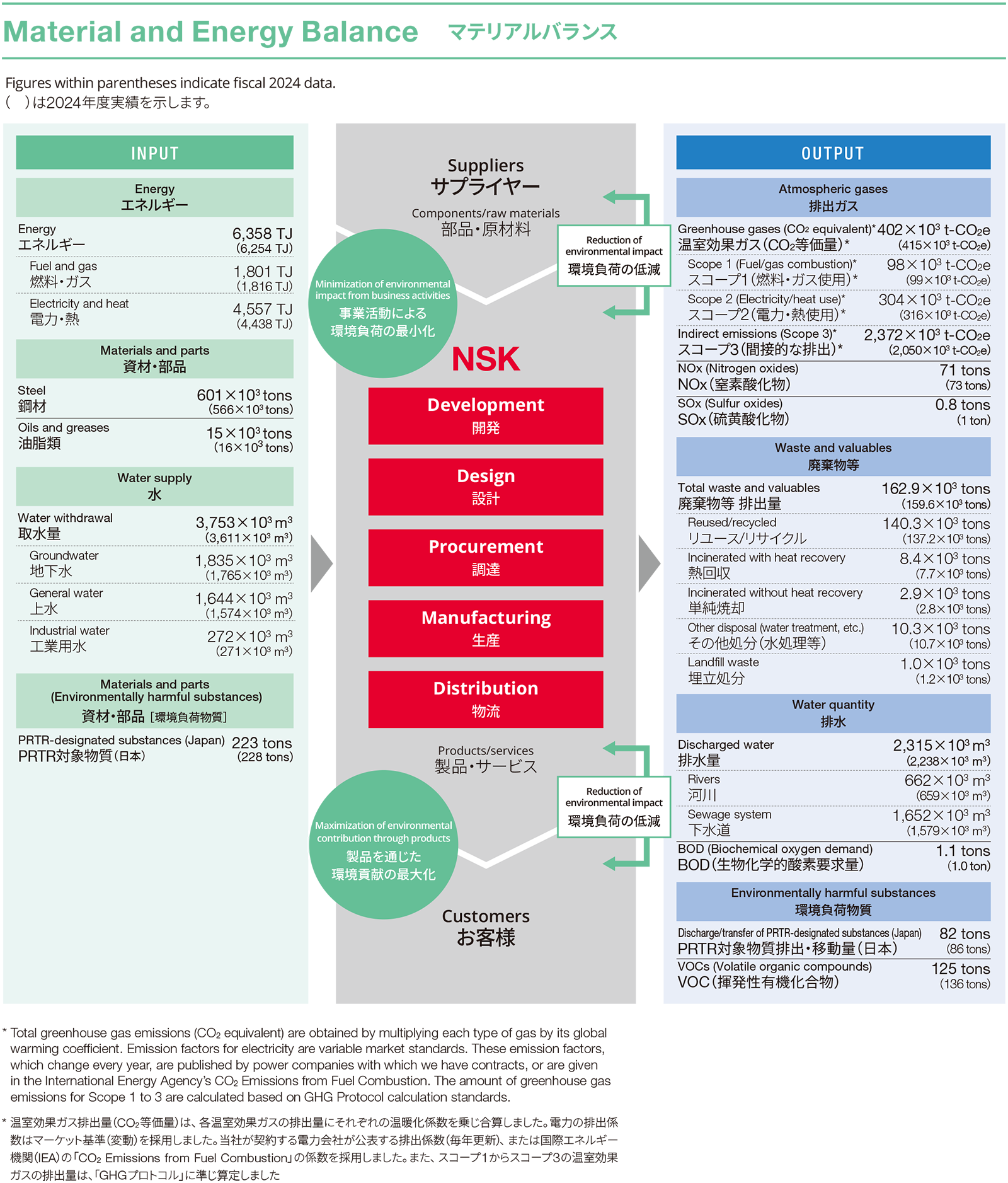
The NSK Group established the NSK Environmental Policy and the NSK Environmental Code of Conduct in 1997 to reflect its commitment, which spans all of its business operations, to help protect the global environment. In line with this policy, we strive to develop products and services that help reduce environmental impact, and to practice business operations that seek to reduce environmental impact throughout the value chain.
In November 2021, we revised the NSK Environmental Policy* and the NSK Environmental Code of Conduct* in light of growing international attention to environmental issues in recent years and rising expectations for corporate action to address these issues.
*Approved by the Representative, Executive Officer, President and CEO on November 15, 2021 after being deliberated by the relevant officers at the Global Environment Protection Committee meeting in September 2021.
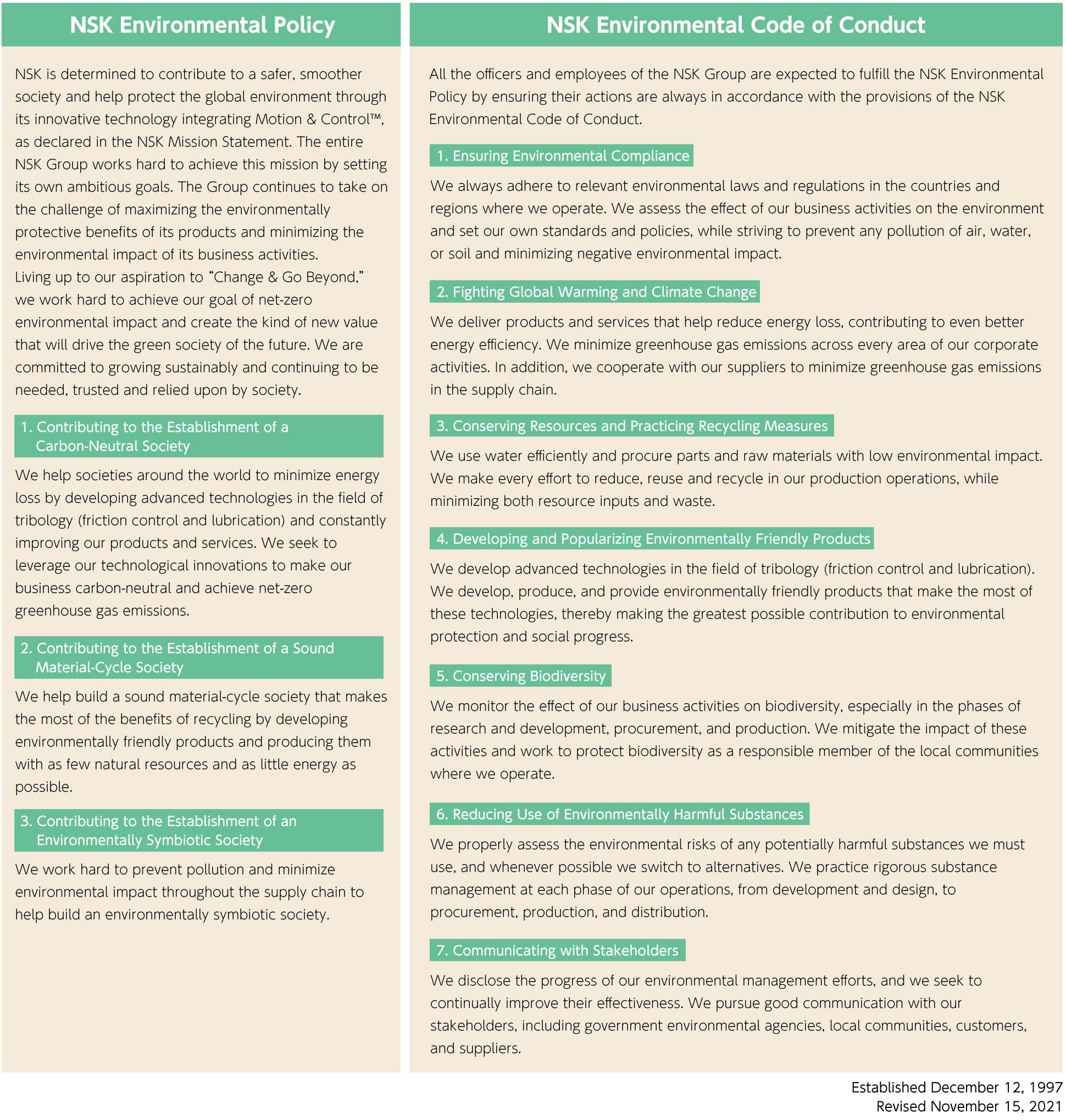
The NSK Group has established the Environmental Action Plan to promote ESG management, one of the key issues of MTP2026. In our practice of global environmental management and environmental compliance, we envision “Contributing to the establishment of a carbon-neutral society,” “Contributing to the establishment of a sound material-cycle society,” and “Contributing to the establishment of an environmentally symbiotic society.” To help achieve this vision, we are minimizing the environmental footprint of our business activities and maximizing the environmental contribution made by our products. This is also linked to helping to achieve the SDGs.
NSK Group Environmental Action Plan
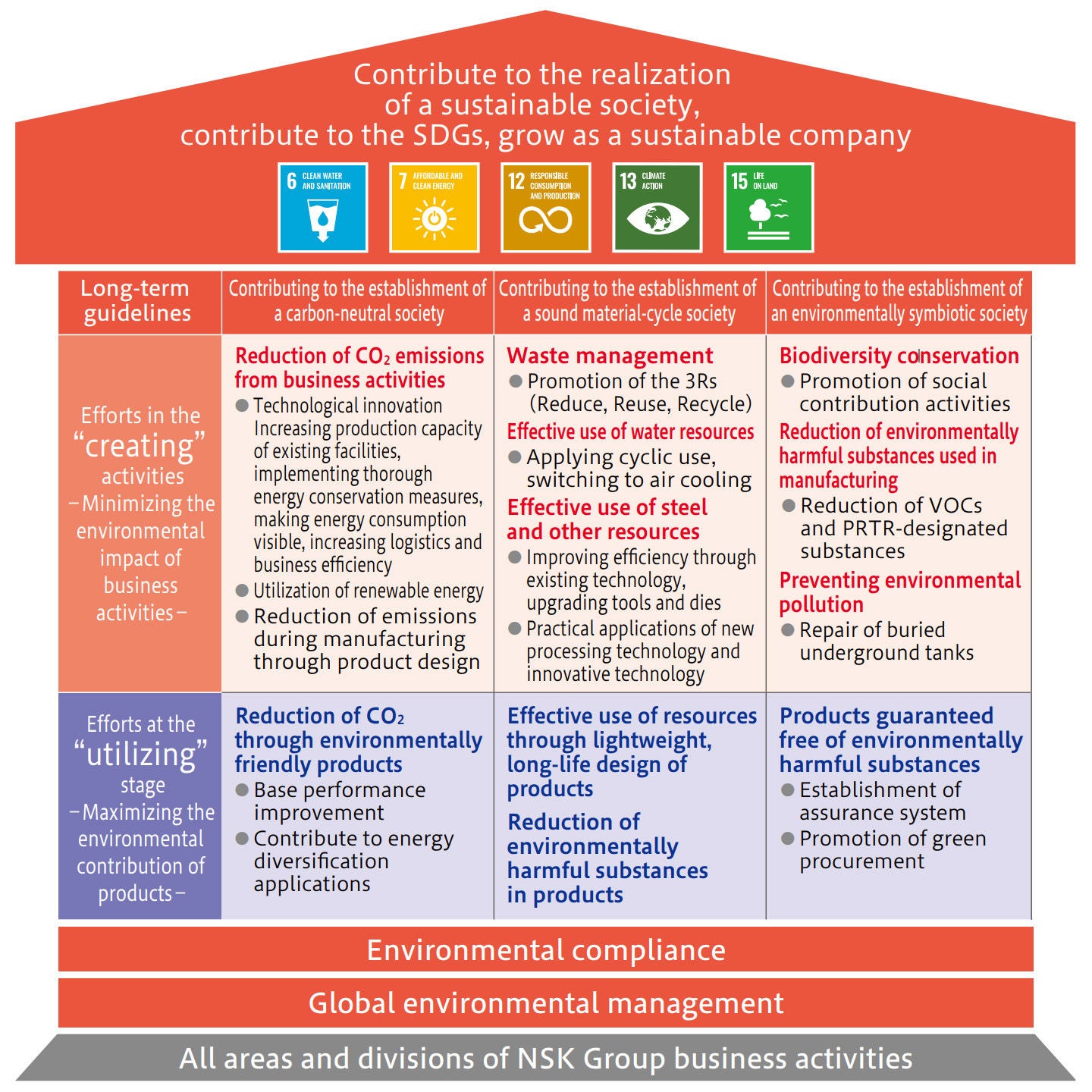
Environmental Risks and Opportunities
In the drive to build a sustainable world, efforts are accelerating to strengthen national and regional regulations and to develop initiatives that encourage measures to reduce CO2 emissions, recycle resources, and reduce environmentally harmful substances. Corporate developments also show progress, in areas such as the electrification of automobiles. In line with this, progress is being made in areas such as the electrification of automobiles. Doing its part, the NSK Group identifies and evaluates environmental opportunities and risks in each phase of the value chain and reflects these in its management strategy and environmental action plan to achieve continuous growth. See the diagram below for specific risks and opportunities.
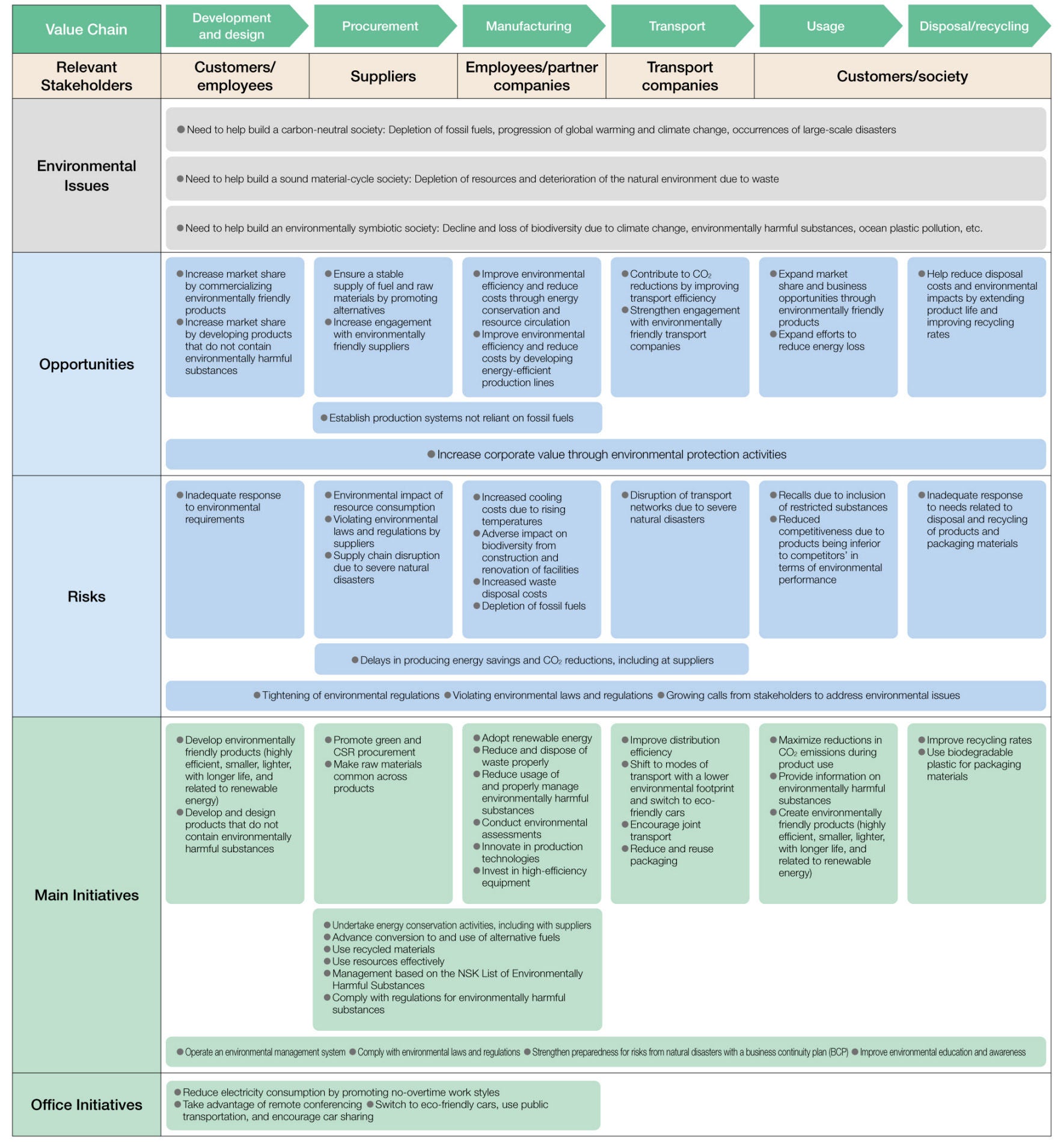
Material and Energy Balance
The NSK Group works with suppliers to reduce environmental impact through efforts such as green procurement and other initiatives. We also strive to reduce the environmental impact of our customers and of society as a whole by providing environmentally friendly products.
Input and Output of Global Business Activities (FY2024 and 2025)
System
◆Environmental Promotion System
Each department implements various measures to achieve NSK Group Environmental Action Plan and continuously monitors and evaluates its progress.
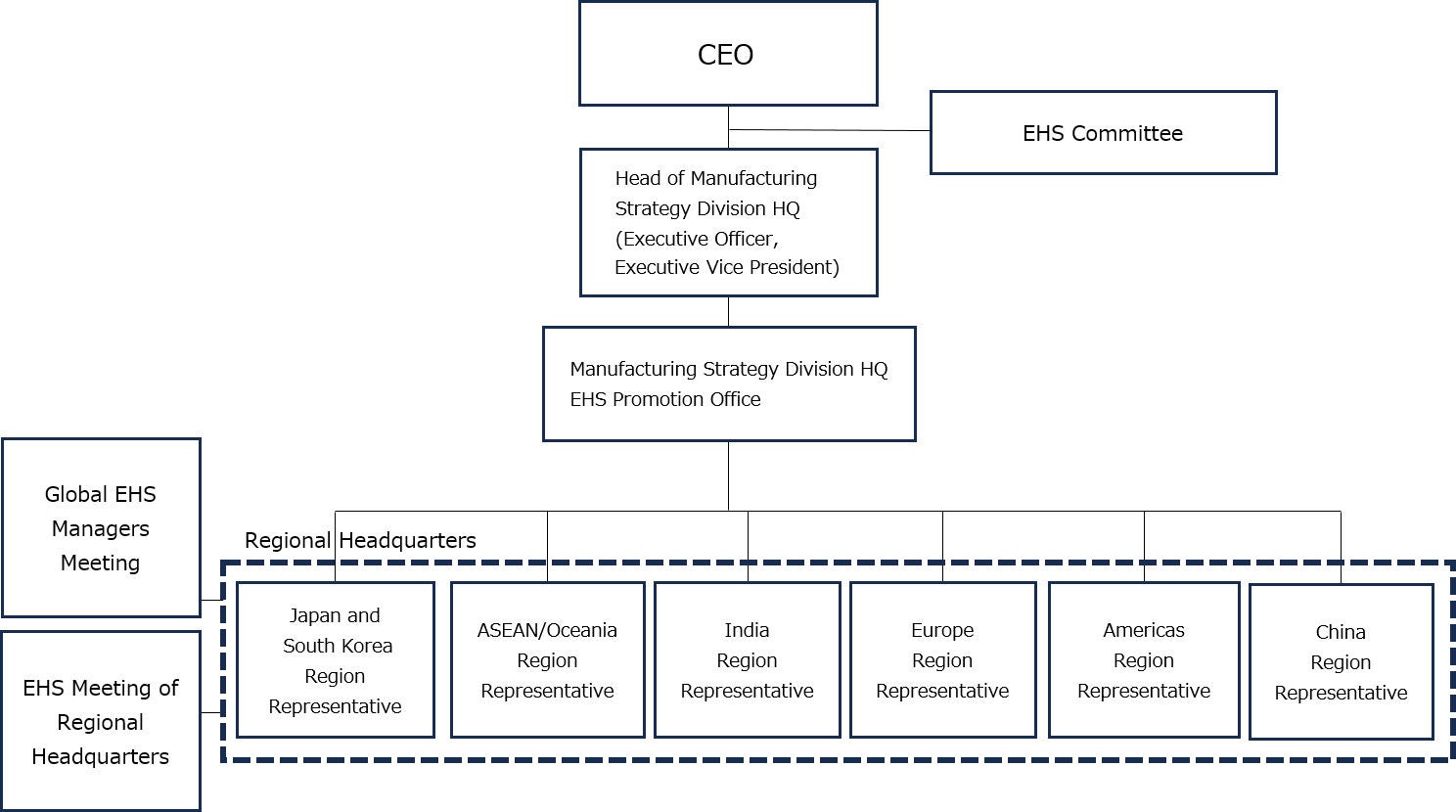
Initiatives related to the environment are regularly reported to the Sustainability & Core Values Committee. The Committee discusses policies to strengthen activities related to the environment, which is one of NSK’s core values, and considers related risks, so that it can suggest improvements to address issues. In particular, with regard to initiatives on carbon neutrality, which is an essential management issue, the Carbon Neutrality Department sets policies, strategies, and targets from a companywide and mid- to long-term perspective, promoting various measures to achieve goals. Progress is regularly reported to the executive officer in charge and the CEO. Particularly critical measures are decided by the CEO following discussions by the Operating Committee and are deliberated by the Board of Directors. The Board of Directors supervises the implementation of these initiatives. The degree of achievement of targets to reduce CO2 emissions is incorporated into the evaluation criteria for the short-term performance-based compensation of executive officers. Environmental initiatives other than those targeting carbon neutrality (with the exception of biodiversity initiatives, which are managed differently), are communicated from the EHS Promotion Office at the Manufacturing Strategy Division HQ through the regional headquarters and promoted by NSK Group companies, just like safety management initiatives.
In addressing issues in each region, the EHS Meeting (attended by the Manufacturing Strategy Division HQ head, plant heads, and executive officers of each Business Division HQ) determines annual policy and holds discussions on the progress made four times a year. The EHS Meeting collaborates with the Global EHS Managers Meeting (attended by EHS managers from each region) to discuss issues and share information on initiatives.
*For more information on the Sustainability & Core Values Committee, please visit NSK’s Corporate Governance Structure.
Global EHS Operating Structure
Goals, Targets, and Achievements
◆Mid-Term Management Plan 2026 (MTP2026) Goals, with Targets and Achievements for Each Fiscal Year
| MTP2026 Goals | FY2025 Targets | FY2025 Achievements | ||
|---|---|---|---|---|
| Environmental management | Achieve and maintain ISO 14001 certification at all subject sites*1 | Achieve and maintain ISO 14001 certification at all subject sites | Achieved and maintained ISO 14001 certification at all subject sites | |
| No serious violations of environmental laws and regulations | No serious violations of environmental laws and regulations | No serious violations of environmental laws and regulations | ||
| No serious incidents of environmental pollution | No serious incidents of environmental pollution | No serious incidents of environmental pollution | ||
| Creating environmentally friendly products | Create environmentally friendly products with a Neco score of 1.2 or higher (ongoing) | Develop 3 environmentally friendly products | No applicable products*2 | |
| Avoid emissions*3 through the use of NSK products of at least 2.65 million t-CO2 | 2.51 million t-CO2 | 2.60 million t-CO2 | ||
| Climate change measures | Manufacturing, technology, offices | CO2 emissions*4: 50% reduction from FY2017 | 44% reduction from FY2017 | 59.5% reduction from FY2017 |
| Energy usage per unit of sales: 10% reduction from FY2017 | 8.8% reduction from FY2017 | 13.1% reduction from FY2017 | ||
Resource circulation
| Manufacturing, technology, offices | Industrial waste per unit of sales: | Below -8.0% (base year FY2017) | -16.3% (base year FY2017) |
Maintain a recycling rate of at least 99% | 99% or higher | 99.3% | ||
| Waste plastic per unit of sales: Below -3.0% (base year FY2023) | Below -2.0% (base year FY2023) | -13.0% (base year FY2023) | ||
Distribution (Japan) | Packaging waste per unit of sales: Below -14% (base year FY2021) | Below -12% (base year FY2021) | -51.1% (base year FY2021) | |
| Resource circulation - Utilization of water resources | Manufacturing, technology, office | Water withdrawal per unit of sales: Below -9% (base year FY2017) | Below -8% | -13.9% (base year FY2021) |
| Reducing use of environmentally harmful substances | Development and design, procurement, manufacturing | Full response to the 10 EU RoHS substances | Thoroughly manage by carrying out ongoing product content surveys and component analysis | Promoted compliance with RoHS regulations by managing chemical substances in products |
| Procurement | Conduct survey regarding inclusion of substances on the NSK List of Environmentally Harmful Substances | Conduct supplier audits of the management systems for environmentally harmful substances | Carried out supplier audits of the management systems for environmentally harmful substances and promoted improvements in level of management | |
| Obtain responses from all target suppliers | Implemented activities to prevent contamination by prohibited substances through expansion of survey on inclusion of environmentally harmful substances | |||
Manufacturing (Japan) | Handling of PRTR-designated substances per unit of sales: Continue to reduce by 1% year on year | Below -1% (base year FY2024) | -10.9% (base year FY2024) | |
| Biodiversity conservation | Identify the factors in operations that could have a negative impact on biodiversity | Continue activities | Continued activities | |
| Expand social contribution activities related to biodiversity conservation | Continue activities | Continued activities | ||
| Educate to deepen employee awareness of issues | Continue activities | Continued activities | ||
*1 Sites with particularly large environmental impacts, including development, design, manufacturing, and distribution
*2 In FY2025, we developed and announced new products that contribute to resource circulation and electrification, such as a cooking oil deterioration suppression filter and an electrical bypass plate. However, there were no new products that met the criteria for certification with a Neco Score of 1.2 or higher.
*3 The value for avoided emissions is affected each year due to changes in the electricity emissions factor. Therefore, both goals and achievements use values converted for the most current electricity emissions factor.
*4 Total greenhouse gas emissions (CO2 equivalent) are obtained by multiplying each type of gas by its global warming coefficient. Emission factors for electricity are variable market standards. These emission factors, which change every year, are published by power companies with which we have contracts, or are given in the International Energy Agency’s CO2 Emissions from Fuel Combustion.
◆Mid-Term Management Plan 2028 (MTP2028) Goals, with Targets and Achievements for Each Fiscal Year
| MTP2028 Goals | FY2026 Targets | ||
|---|---|---|---|
| Environmental management | Achieve and maintain ISO 14001 certification at all subject sites*1 | Achieve and maintain ISO 14001 certification at all subject sites | |
| No serious violations of environmental laws and regulations | No serious violations of environmental laws and regulations | ||
| No serious incidents of environmental pollution | No serious incidents of environmental pollution | ||
| Climate change measures | Manufacturing, technology, offices | CO2 emissions*2: at least 61% reduction from FY2017 | 50% reduction from FY2017 |
| Energy usage per unit of sales: at least 19% reduction from FY2017 | 10% reduction from FY2017 | ||
Resource circulation
| Manufacturing, technology, offices | Industrial waste per unit of sales: Below -11.0% | Below -9.0% (base year FY2017) |
Maintain a recycling rate*3 of at least 99% | 99% or higher | ||
| Waste plastic per unit of sales: Below -5.0% (base year FY2023) | Below -3.0% (base year FY2023) | ||
| Resource circulation - Utilization of water resources | Manufacturing, technology, office | Water withdrawal per unit of sales: Below -11.0% (base year FY2017) | Below -9.0% |
| Reducing use of environmentally harmful substances | Development and design, procurement, manufacturing | Ensure compliance with global environmental regulations by strengthening management of environmentally harmful substances in products | Implement management of chemical substances in products based on developments in environmental regulations, including RoHS, REACH, PFAS, and PPWR |
| Procurement | Strengthen management systems for environmentally harmful substances in the supply chain | Prevent contamination with prohibited substances through supplier audits and surveys on inclusion of environmentally harmful substances | |
| Manufacturing (Japan) | Strengthen management and promote substitution of substances regulated by the PRTR Law | Strengthen management and promote substitution of substances regulated by the PRTR Law to reduce environmental impact | |
| Handling of PRTR-designated substances per unit of sales: Continue to reduce by 1% year on year | Below -1% (base year FY2025) | ||
| Biodiversity conservation | Identify the factors in business operations that could have an impact on biodiversity | Confirm management status at priority verification sites | |
| Register nationally certified sustainably managed natural sites (“kyosei sites”) and provide support | Select priority sites | ||
| Expand social contribution activities related to biodiversity conservation | Continue activities | ||
*1 Sites with particularly large environmental impacts, including development, design, manufacturing, and distribution
*2 Total greenhouse gas emissions (CO2 equivalent) are obtained by multiplying each type of gas by its global warming coefficient. Emission factors for electricity are variable market standards. These emission factors, which change every year, are published by power companies with which we have contracts, or are given in the International Energy Agency’s CO2 Emissions from Fuel Combustion.
*3 Recycling rate is calculated using the volume of valuable materials and the volumes of waste that are reused and recycled.
Initiatives
◆Global Environmental Management
Acquiring and Maintaining Environmental Management Certification
The NSK Group establishes environmental management at all sites. Environmental initiatives are important at sites involved in development, design, manufacturing, and distribution because these processes have especially large environmental impacts. We require these sites to obtain external ISO 14001 certification—the international standard for environmental management systems—within three years of full-scale operation for the start of mass production including new plant establishment and M&A.
Additionally, we work to bolster the effectiveness of our management system at the global level by setting targets, making continuous improvements, and undergoing regular third-party audits. Further, the environmental impact of our ISO 14001 certified sites in terms of energy use, GHG emissions, water consumption, and waste emissions accounts for over 95% of the entire Group’s environmental impact.
We encourage sites that have not yet obtained ISO 14001 certification to obtain external certification, while also enhancing the effectiveness of management systems by implementing environmental management operations and internal audits conducted by qualified ISO14001 internal auditors certified by external organizations, as well as holders of public or in-house qualifications with the knowledge and skills necessary to prevent environmental pollution.
◆Environmental Compliance
Environmental Compliance
In addition to compliance with environment-related laws and regulations, the NSK Group does more than merely comply with environmental laws and regulations; we adhere to rigorous internal standards that go beyond legal obligations to prevent air and water pollution. In the event of an accident or legal violation that has an impact on the external environment, we promptly report the matter to administrative authorities, investigate the cause, and implement measures to prevent recurrence.
Environmental Audits
Each NSK Group site conducts regular internal audits carried out by qualified ISO 14001 internal auditors and personnel who hold public or in-house qualifications with the knowledge and skills necessary to prevent environmental pollution, such as air or water pollution, as well as third-party audits. Additionally, to ensure prevention of oil leakages and spills, compliance with environment-related laws and and regulations and proper management of waste and environmentally harmful substances, we conduct audits similar to the internal audits using audit checklists and an environmental pollution risk assessment methodology established by the NSK Group and carried out by qualified personnel from the regional headquarters and the EHS Promotion Office at the Manufacturing Strategy Division HQ.
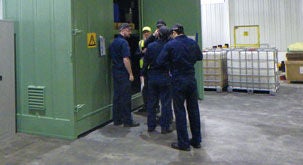
Environmental audit (Europe)
- Remediating Soil and Groundwater Pollution
The NSK Group completely eliminated the use of chlorinated organic solvents by FY2003. However, we are continuing to clean up six sites where past use has left traces of contamination in soil and groundwater. We regularly monitor groundwater and report our progress to agencies.
◆Other Initiatives
- Environmental Education
The NSK Group recognizes that the key to increasing the effectiveness of environmental protection initiatives is for every employee to perform their daily work based on sound knowledge. This is why we continuously offer training to raise employees’ environmental awareness and to deepen their knowledge. Training includes level-specific environmental education for all employees, from new hires to experienced veterans, on such themes as environment management, carbon neutrality, energy conservation, resource conservation (water resources and waste), management of environmentally harmful substances and building an environmentally symbiotic society; environmental e-learning; training tailored to different objectives for the environmental managers in each department; and education for engineers.
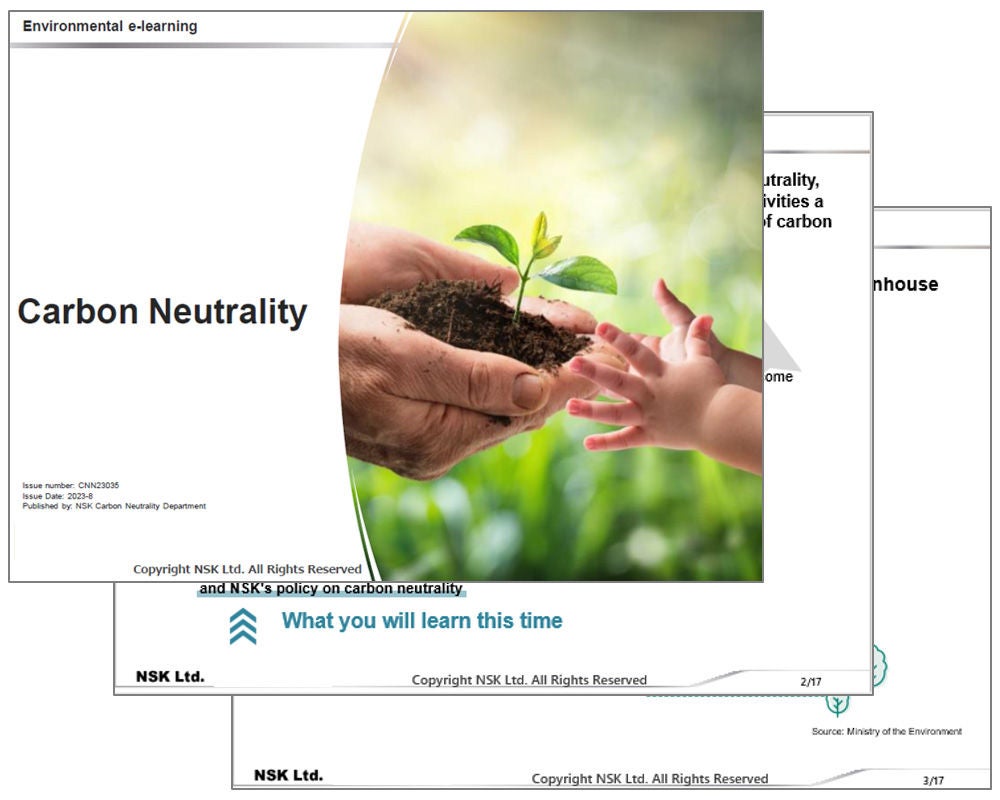
Excerpt from “Carbon Neutrality” e-learning program