

Reducing Use of Environmentally Harmful Substances
NSK’s Approach
In recent years, international regulations on chemical substances have been tightening, and companies are increasingly required to respond swiftly and appropriately to new legal requirements. The NSK Group regards thorough legal compliance as a foundation of its corporate activities, and is working to strengthen its ability to comply with laws and regulations both in and outside Japan.
As part of these efforts, the Group actively collects and analyzes the latest regulatory information — by participating in relevant seminars, regularly checking government gazettes, and consulting with relevant authorities — to obtain timely information on legal revisions, and shares it internally. In the European Union, a Digital Product Passport (DPP) framework for companies to manage and provide product information electronically is scheduled to begin implementation in 2026. This will require firms to adopt more advanced information management systems. In preparation for DPP implementation, the NSK Group is developing a way to systematically manage and provide accurate, comprehensive information on the chemical substances and materials contained in its products. By introducing a chemical substance management system and enhancing its information infrastructure, the Group will be able to centrally manage product chemical data, enabling efficient and reliable compliance with regulations while sharing information internally and externally.
Furthermore, based on the NSK List of Environmentally Harmful Substances, the Group rigorously manages and reduces chemical substance use at every stage, from development and design to procurement, production, and logistics. For environmental impacts from plant exhaust gases and wastewater, the Group has established its own voluntary standards that are stricter than legal requirements, and works diligently on environmental protection. It also requires suppliers to follow the NSK Group Green Procurement Standards and other guidelines, thereby promoting chemical substance management throughout the supply chain.
Looking ahead, the NSK Group will continue to respond accurately to international regulatory trends while aiming to balance product safety with environmental responsibility, contributing to sustainable manufacturing.
System
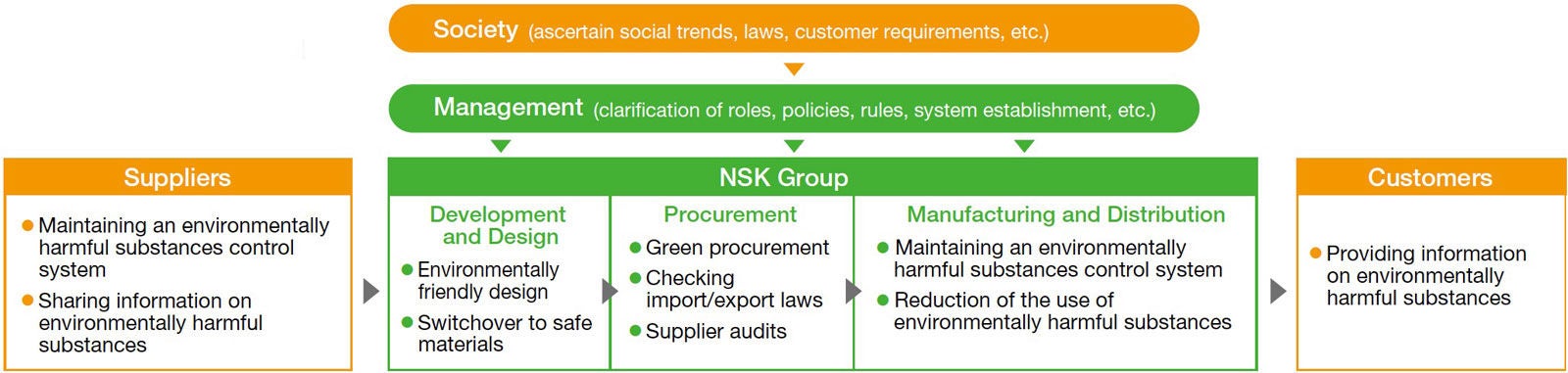
To reduce the environmental impact of the entire value chain, the NSK Group maintains a system for managing environmentally harmful substances. We develop rules for the management of environmentally harmful substances in accordance with laws, regulations, and industry standards related to the chemical substances that must be managed.
Management of Environmentally Harmful Substances
Goals, Targets and Achievements
◆Mid-Term Management Plan 2026 (MTP2026) Goals, with Targets and Achievements for Each Fiscal Year
| MTP2026 Goals | FY2025 Targets | FY2025 Achievements | Initiatives | |
|---|---|---|---|---|
Development and design, procurement, and manufacturing | Full response to the 10 EU RoHS substances | Thoroughly manage by carrying out ongoing product content surveys and component analysis | Promoted compliance with RoHS regulations by managing chemical substances in products |
|
| Procurement | Conduct survey regarding inclusion of substances on the NSK List of Environmentally Harmful Substances | Conduct supplier audits of the management systems for environmentally harmful substances | Carried out supplier audits of the management systems for environmentally harmful substances and promoted improvements in level of management |
|
| Obtain responses from all target suppliers | Implemented activities to prevent contamination by prohibited substances through expansion of survey on inclusion of environmentally harmful substances |
| ||
| Manufacturing (Japan) | Handling of PRTR-designated substances per unit of sales: Continue to reduce by 1% year on year | Below -1% (base year FY2024) | -10.9% (base year FY2024) |
|
◆Mid-Term Management Plan 2028 (MTP2028) Goals, with Targets and Achievements for Each Fiscal Year
| MTP2028 Goals | FY2026 Targets | |
|---|---|---|
Development and design, procurement, and manufacturing | Ensure compliance with global environmental regulations by strengthening management of environmentally harmful substances in products | Implement management of chemical substances in products based on developments in environmental regulations, including RoHS, REACH, PFAS, and PPWR |
| Procurement | Strengthen management systems for environmentally harmful substances in the supply chain | Prevent contamination with prohibited substances through supplier audits and surveys on inclusion of environmentally harmful substances |
| Manufacturing (Japan) | Strengthen management and promote substitution of substances regulated by the PRTR Law | Strengthen management and promote substitution of substances regulated by the PRTR Law to reduce environmental impact |
| Handling of PRTR-designated substances per unit of sales: Continue to reduce by 1% year on year | Below -1% (base year FY2025) | |
Initiatives
- 2006:Implemented product design and management in compliance with the EU RoHS Directive*1 and ELV Directive*2
- 2020:Implemented product design and management in compliance with the revised EU RoHS Directive*3 (including phthalates)
- 2022:Completed full elimination of materials containing PFOA in accordance with the EU REACH Regulation
- 2023:Started investigation and review for measures in response to regulatory trends on PFAS
- 2024:Started establishing a chemical substance information management system in preparation for the EU Digital Product Passport (DPP)
- 2025:Promoted establishment of management system to ensure compliance with new environmental regulations, including PPWR*4
*1 RoHS Directive: An EU directive that restricts the use of six harmful substances in electric and electronic devices
*2 ELV Directive: An EU directive that prohibits the use of lead, mercury, cadmium, and hexavalent chromium in automotive parts and materials in order to promote the recycling of end of life vehicles
*3 Revised RoHS Directive: The revised RoHS Directive issued in 2014, now including phthalates and other substances added in 2019, restricts the use of 10 substances.
*4 PPWR (Packaging and Packaging Waste Regulation): An EU regulation on use, recyclability, and reduction in environmental impact of packaging materials
Green Procurement and Management of Environmentally Harmful Substances
The NSK Group believes that addressing increasingly serious global environmental issues requires initiatives not only within the group but throughout the entire supply chain, and the group actively promotes green procurement. Environmentally hazardous substances, identified independently based on laws and industry standards, are registered in the NSK List of Environmentally Harmful Substances.*1 The NSK Group Green Procurement Standards have also been established to ensure that parts, materials, lubricants, packaging materials, and other items containing or contaminated with prohibited substances are not delivered to plants. Based on these guidelines, suppliers are requested to maintain strict substance management and continuously improve their systems. Specifically, the Group strengthens collaboration with its business partners by obtaining their agreement to follow the NSK Group Green Procurement Standards, conducting regular surveys on environmentally harmful substances, auditing key suppliers, and promptly requesting corrective action if any issues are identified. In FY2025, we conducted surveys on environmentally harmful substances at approximately 400 suppliers and verified the status of compliance with applicable laws and regulations as well as NSK’s requirements. Across these efforts, no sales of products containing prohibited substances were found during the reporting period.
We also incorporated substances that may be regulated in future, starting with PFAS, into the NSK List of Environmentally Harmful Substances and moved forward with efforts to identify the presence of such substances in the supply chain and to management them appropriately.
NSK products are supplied to global multinationals, and the final products in which they are incorporated — ranging from automobiles to electrical and electronic equipment — must comply with laws and regulations on environmentally hazardous substances in countries worldwide. To respond accurately to these regulatory trends, the Group updates the NSK List of Environmentally Harmful Substances.
In FY2025, in addition to the REACH Regulation,*2 we incorporated PFAS and substances that may be regulated in the future, thereby expanding the substances subject to management. Furthermore, we moved forward with efforts for appropriate management and tracking of information on chemical substances contained in our products, parts, and materials, taking account of trends in laws, regulations, and industry standards.
In addition, the NSK Group conducts annual surveys on environmentally harmful substances to strengthen collaboration with suppliers. This approach not only improves the accuracy of regulatory compliance but also establishes a system that can respond quickly and accurately to customer requests for information on chemical substances contained in our products.
*1 A list classifying environmentally harmful substances as “prohibited” (substances that must not be included in or with delivered products), “reduced” (substances that will be reduced systematically), or “under observation” (substances whose inclusion must be monitored). We review the list every year based on trends in laws, regulations, and industry standards. In the 2025 edition, we added PFAS and substances that may be regulated in the future, thereby expanding the substances subject to management. In addition, we proceeded with the transition from managing chemical substances individually to managing them in accordance with the laws and regulations of each country in order to reduce the burden on suppliers and improve internal management efficiency.
*2 Regulation on the Registration, Evaluation, Authorisation, and Restriction of Chemicals (REACH) in the European Union
Provision of Product Safety and Chemical Substance Information
At NSK, we prepare and provide Safety Data Sheets (SDS) to ensure the safe use of our products. For certain products, we also publish SDSs on our website to enhance transparency and accessibility of information. In line with Japan’s revised Industrial Safety and Health Act that came into effect in April 2025, we updated the SDSs for applicable products ahead of enforcement and completed their provision to customers. Furthermore, to more clearly communicate information on safe use, such as recommended applications and required protective equipment, we are reviewing and updating the content of SDSs on an ongoing basis.
Compliance with the European RoHS Directive and Management of Harmful Substances in Manufacturing Processes
To ensure that the ten substances prohibited under the European RoHS Directive are not contained in its products, the NSK Group compiles lists of parts verified as free of these substances based on supplier survey results. These lists are used not only during product design verification but also when receiving parts at each plant, serving as part of our management system to prevent the unintentional inclusion of prohibited substances. The European RoHS Directive initially prohibited six substances, including cadmium, lead, mercury, and hexavalent chromium, with four types of phthalates added in July 2019. These phthalates are known to have migratory properties, meaning they can transfer to other materials upon contact, making them a particular concern for product safety. Accordingly, the NSK Group conducts global surveys not only on the materials and components of its products to ensure non-use, but also on contact materials used in manufacturing processes — such as resins, rubber gloves, and packaging materials. Through these efforts, we continue to eliminate the risk of phthalate migration during manufacturing and advance initiatives to maintain product quality and safety.
Management and Promotion of Substitution of Substances Regulated under the PRTR Law
At its main production sites in Japan, the NSK Group is working to manage appropriately and promote substitution of substances regulated under the PRTR Law.*
We aim to reduce the volume per unit of sales of PRTR-designated substances handled by 1% each year compared to the previous fiscal year. In FY2025, by measures such as switching cleaning agents to Type 3 petroleum products, the volume handled per unit was reduced by 10.9% year on year. In manufacturing processes that use solvents, adhesives, and other materials containing volatile organic compounds (VOCs), we are promoting initiatives such as switching to low-VOC products and improving processes. In FY2025, the Group’s global VOC emissions amounted to 125 tons.
The NSK Group continually promotes the substitution of regulated substances for applications for which it is technically feasible from the perspectives of reducing environmental impact and occupational health and safety.
* Law concerning Pollutant Release and Transfer Register (PRTR): Act on Confirmation, etc., of Release Amounts of Specific Chemical Substances in the Environment and Promotion of Improvements to the Management Thereof. Japan’s law intended to facilitate improvement of chemical substance management by ensuring that amounts released into the environment are ascertained and reported to authorities.
Regulatory Compliance
When launching new products, chemical substance notification, registration, and volume reporting are required in accordance with various national regulations. The NSK Group ensures appropriate and reliable compliance with such regulatory requirements, including obligations to submit data on existing chemical substances under revised and newly enforced regulations worldwide. In responding to regulations outside Japan, we have continued to manage export volumes of chemical substances under the EU REACH Regulation and, after reviewing the regulatory requirements, have taken the necessary measures. In FY2024, the NSK Group had no violations of laws and regulations relating to chemical substance registration or notification. We are also preparing for the registration of existing chemical substances under South Korea’s K-REACH* law, and are steadily moving forward to meet the registration deadline of December 2027. Through these initiatives, the NSK Group is fulfilling its responsibilities not only for legal compliance but also for environmental protection and safety assurance, thereby contributing to the advancement of sustainable business activities.
* K-REACH (Act on the Registration and Evaluation of Chemical Substances): A regulatory framework in South Korea requiring phased registration of chemical substances manufactured or imported into the country, depending on annual import volumes.
Risk Assessment of Product Chemical Substances and Advancement of Supply Chain Management
To strengthen the risk assessment of chemical substances contained in its products, the NSK Group conducts assessments in compliance with key market regulations such as the EU REACH Regulation and TSCA,*1 using toxicological databases such as those of the European Chemicals Agency*2 and the U.S. Environmental Protection Agency.*3 In FY2024, we completed risk assessments for nearly 100% of products by sales volume, thereby promoting both product safety and environmental considerations. For supply chain management, we conduct annual supplier audits using a checklist from the Joint Article Management Promotion-consortium (JAMP) and share initiatives for chemical substance management through procurement policy briefings. These efforts help strengthen collaboration with suppliers and enhance information transparency. In addition, for chemical substances used in production processes, each NSK Group plant acquires and manages SDSs, and they record PRTR-designated substances and subject them to third-party verification, thereby ensuring both proper management of environmentally harmful substances and external reliability.
*1 TSCA (Toxic Substances Control Act): A United States law that regulates the manufacture, import, use, etc. of chemical substances. It is operated with the goal of protecting human health and the environment.
*2 The ECHA implements and enforces the EU REACH Regulation.
*3 The EPA conducts hazard assessments and regulates chemical substances in the United States.
Strengthening Global Management Systems for Chemical Substances
The NSK Group is working to strength global management systems for chemical substances in order to comply with chemical substance regulations which are being tightened in countries around the world. In addition to clarifying the responsibilities and roles in each region and business division, we share management status and issues through regular meetings and implement continuous improvement activities. We are also developing rules and regulations related to management of chemical substances and working to build an integrated management system across the Group.
Promoting Education on the Management of Chemical Substances
The NSK Group provides education for relevant departments as part of its efforts to strengthen management systems for chemical substances. In FY2025, we provided education on the management of chemical substances in products through e-learning, thereby promoting the establishment of the management system and improving employee competency.
Sharing and Dissemination of Information on Environmental Regulations
The NSK Group continuously collects and analyzes information on legal and regulatory trends related to chemical substances in and outside Japan and shares this information within the group. By sharing the latest trends for various regulations, including the REACH Regulation, RoHS Directive, and PFAS regulations, with the relevant departments, we support swift and accurate compliance in product development, procurement, and production. We also conduct assessments of impact due to revisions of laws and regulations and consider response policy, striving to strengthen legal compliance on a global basis.