
Development of a Lubricant Temperature Prediction Model
August 2026
Core Technology R&D Center (Stationed at Institute of Science Tokyo)
Technology Development Division Headquarters
1. Introduction
As described in NSK Technical Review No. 2603, “Lubrication Life Formula (Lubrication Pentagon Theory),”1) NSK is developing a technology for theoretically predicting lubrication life in order to achieve both lower torque and longer life in rolling bearings. The Lubrication Pentagon Theory interrelates bearing torque, lubricant temperature, lubricant degradation, viscosity, and oil-film thickness, thereby representing the process by which the oil film becomes thinner and the lubrication condition changes over time. Here, the oil film is a thin layer of lubricant formed at the contact areas inside the bearing; it helps prevent direct metal-to-metal contact. Fig.1 shows the structure of the lubrication life formula.
This article presents our efforts to develop a prediction model for lubricant temperature, one of the components of the theory. Bearing temperature is generally represented by the outer-ring temperature because it is relatively easy to measure. In grease-lubricated bearings, however, the temperature of the lubricant that actually lubricates the contact areas may be higher than the outer-ring temperature. Oxidative degradation of the lubricant, changes in viscosity, and oil-film thickness are all strongly affected by temperature. Consequently, evaluating lubrication performance and lubrication life using the outer-ring temperature may underestimate the actual lubricant temperature and thus overestimate lubrication life. On the other hand, directly measuring the lubricant temperature inside a bearing is challenging.
A method for predicting lubricant temperature from operating conditions is therefore important. More accurate determination of the lubricant temperature inside a bearing can help achieve both lower torque and longer bearing life by preventing premature lubricant degradation. With future integration into the Lubrication Pentagon Theory in mind, this study investigated lubricant-temperature prediction using a thermal network method, which is suitable for iterative calculations and can represent the temperature distribution inside a bearing2).
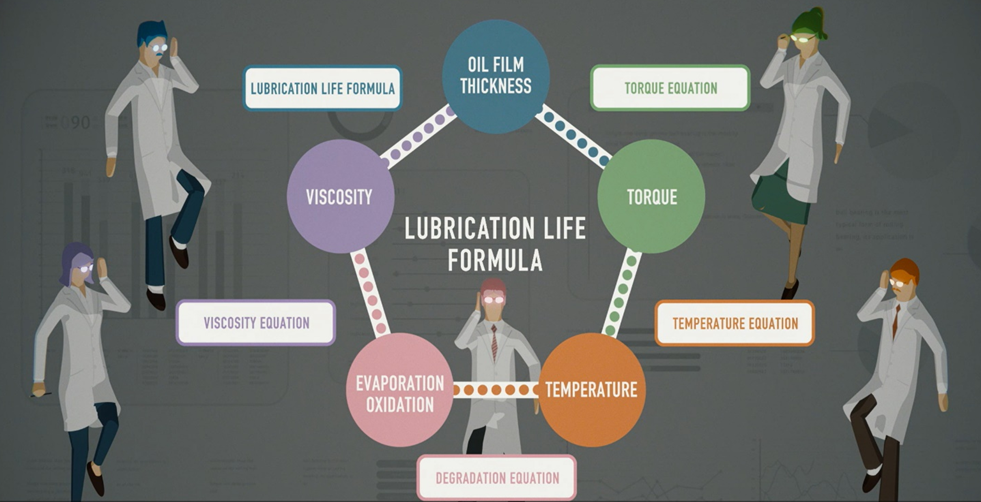
Fig.1 Structure of the Lubrication Life Formula
2. Concept and Method for Predicting Lubricant Temperature: Thermal Network Method
In the Lubrication Pentagon Theory, lubricant temperature is a key factor that governs lubricant degradation, viscosity, and oil-film thickness and therefore has a major influence on lubrication life. Because the theory combines five prediction formulas and performs iterative calculations over time, the method used to determine lubricant temperature must provide the required accuracy in the temperature distribution while imposing only a small computational load. Accordingly, this study applied the thermal network method to lubricant-temperature prediction.
The thermal network method is an analytical technique that treats heat flow as analogous to current flow in an electrical circuit. By associating temperature difference with voltage difference, heat flow with electric current, and thermal resistance with electrical resistance, the temperature distribution in a complex structure can be determined relatively easily.
First, the object to be analyzed is divided into several regions, each represented by a node. The system is then modeled as a network using thermal resistances, which represent the resistance to heat transfer between nodes, and thermal capacitances, which represent the heat-storage characteristics of the region associated with each node. Temperature difference is the driving force for heat transfer, and heat flows from a higher-temperature region to a lower-temperature region. At each node, an energy-balance equation is formulated by considering the heat flow into and out of the node, the heat generated within the node, and the time variation of the node temperature.
The energy balance at node i is expressed by Eq. (1), where T, Q, R, C, and t denote temperature [K], heat generation rate [W], thermal resistance [K/W], thermal capacitance [J/K], and time [s], respectively. Subscripts i and j denote node numbers. The first term on the left-hand side represents the heat-flow term arising from the temperature difference between the nodes.

Solving the energy-balance equations for all nodes simultaneously gives the time variation of the temperature at each node. The system of differential equations can be written as Eq. (2) using the thermal conductance matrix G, temperature vector T, input vector q, and thermal capacitance matrix C. The thermal conductance matrix G is a coefficient matrix composed of the thermal conductances between nodes and those between the nodes and the external environment. The input vector q represents the heat generated at each node and the contributions from prescribed-temperature boundaries.
The off-diagonal elements of G are the thermal conductances between connected nodes, while each diagonal element is the negative sum of the thermal conductances connected to that node. By transforming Eq. (2) into the state equation shown in Eq. (3), the time variation of temperature can be obtained using a numerical integration method such as the Runge–Kutta method.

3. Application of the Thermal Network Method to a Bearing Test Rig
In this study, the thermal network method was applied to a bearing test rig using grease-lubricated bearings. A schematic of the test rig is shown in Fig.2. Two test bearings were subjected to an axial load and rotated during the test.
Type 6305 bearings were used in the test. The ambient temperature was 25 °C, and the axial load was 1,000 N. Urea grease was used as the lubricant, with a fill quantity of 3.4 g. The rotational speed was increased stepwise through 12 speed levels: 500, 630, 870, 1,185, 1,665, 2,190, 2,970, 4,020, 5,400, 7,350, 9,900, and 13,000 min⁻¹.
During the test, bearing torque, rotational speed, and outer-ring temperature were measured. Oil film thickness and the oil film breakdown ratio were also measured by the electrical impedance method3). Bearing torque and rotational speed were used as inputs to the thermal network model, while the outer-ring temperature and oil-film thickness were used to validate the calculated results.
The electrical impedance method is used to evaluate the lubrication condition inside a bearing and to determine the thickness of the oil film formed in the contact region and the oil-film breakdown ratio.
In the thermal network model, the bearing and test rig were divided into multiple regions, each represented by a node. A thermal capacitance was assigned to each node, and the nodes were connected by thermal resistances. In a rotating bearing, the mechanical power dissipated by friction is converted mainly into heat. The rate of heat generation in the bearing can therefore be estimated from the bearing torque and rotational speed. At the present stage, to verify the validity of the lubricant-temperature prediction model, the heat generation rate was calculated from the measured bearing torque and rotational speed and used as an input to the thermal network model. In the future, the model is intended to be combined with the bearing-torque prediction formula in the Lubrication Pentagon Theory so that lubricant temperature can be predicted directly from operating conditions.
The outer-ring temperature predicted by the thermal network method was compared with the measured outer-ring temperature. In addition, the theoretical oil-film thickness was calculated from the estimated lubricant temperature and compared with the oil-film thickness measured by the electrical impedance method.
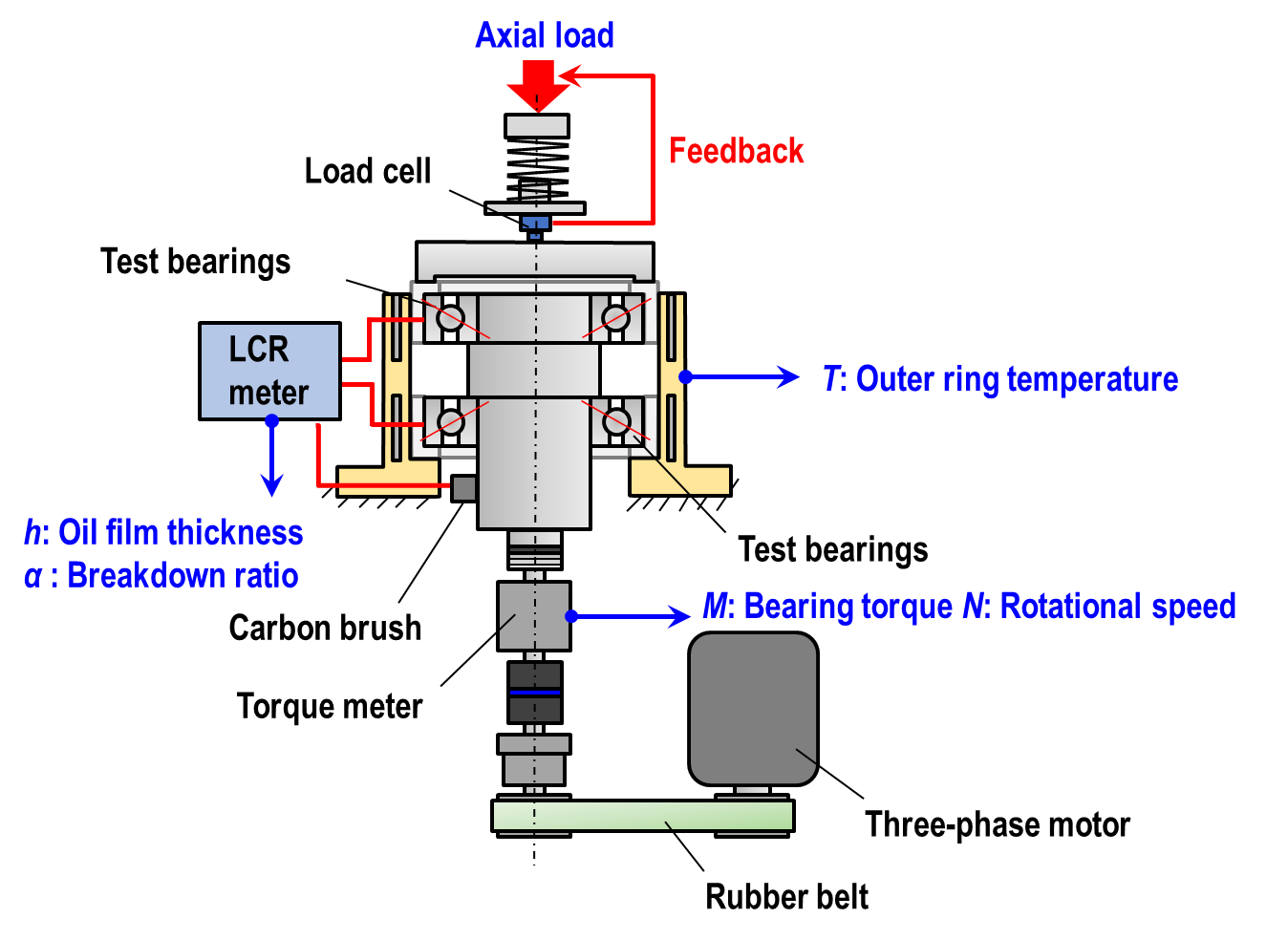
Fig.2 Schematic of the test rig
4. Comparison of Predicted Temperatures with Experimental Results
Fig.3 shows the time histories of torque M, the temperatures at the respective locations T, the oil-film breakdown ratio α, and oil-film thickness h. The outer-ring temperature calculated by the thermal network method, Touter, was in good agreement with the measured outer-ring temperature, Touter_test. This indicates that the developed thermal network model approximately reproduces the thermal behavior of the bearing test rig. The calculated lubricant temperature, Tgrease, tended to be higher than the outer-ring temperature. The difference between the lubricant and outer-ring temperatures became particularly large in the high-speed range.
Next, the theoretical oil-film thickness houter_test was calculated using the measured outer-ring temperature, and hgrease was calculated using the estimated lubricant temperature. These values were compared with the oil-film thickness hEIM measured by the electrical impedance method. The theoretical oil-film thickness calculated using the outer-ring temperature deviated substantially from the measured oil-film thickness. By contrast, when the lubricant temperature predicted by the thermal network method was used, the calculated oil-film thickness was in good agreement with the measured value in the low- to medium-speed range of 500 to 1,185 min⁻¹. This result demonstrates that, when evaluating oil-film thickness in the low- to medium-speed range, it is important to account for the temperature of the lubricant that actually performs the lubrication rather than the more readily measurable outer-ring temperature.
In the high-speed range, however, the theoretical oil-film thickness calculated using the lubricant temperature also deviated from the measured value. The oil-film breakdown ratio α increased in this range. A tendency for torque to decrease despite increasing rotational speed was also observed. These results suggest the onset of lubricant starvation, in which an insufficient amount of lubricant is supplied to the contact. Starvation can reduce oil-film thickness through mechanisms that cannot be explained solely by the decrease in viscosity caused by a temperature rise, and may therefore have contributed to the discrepancy between the theoretical and measured values in the high-speed range.
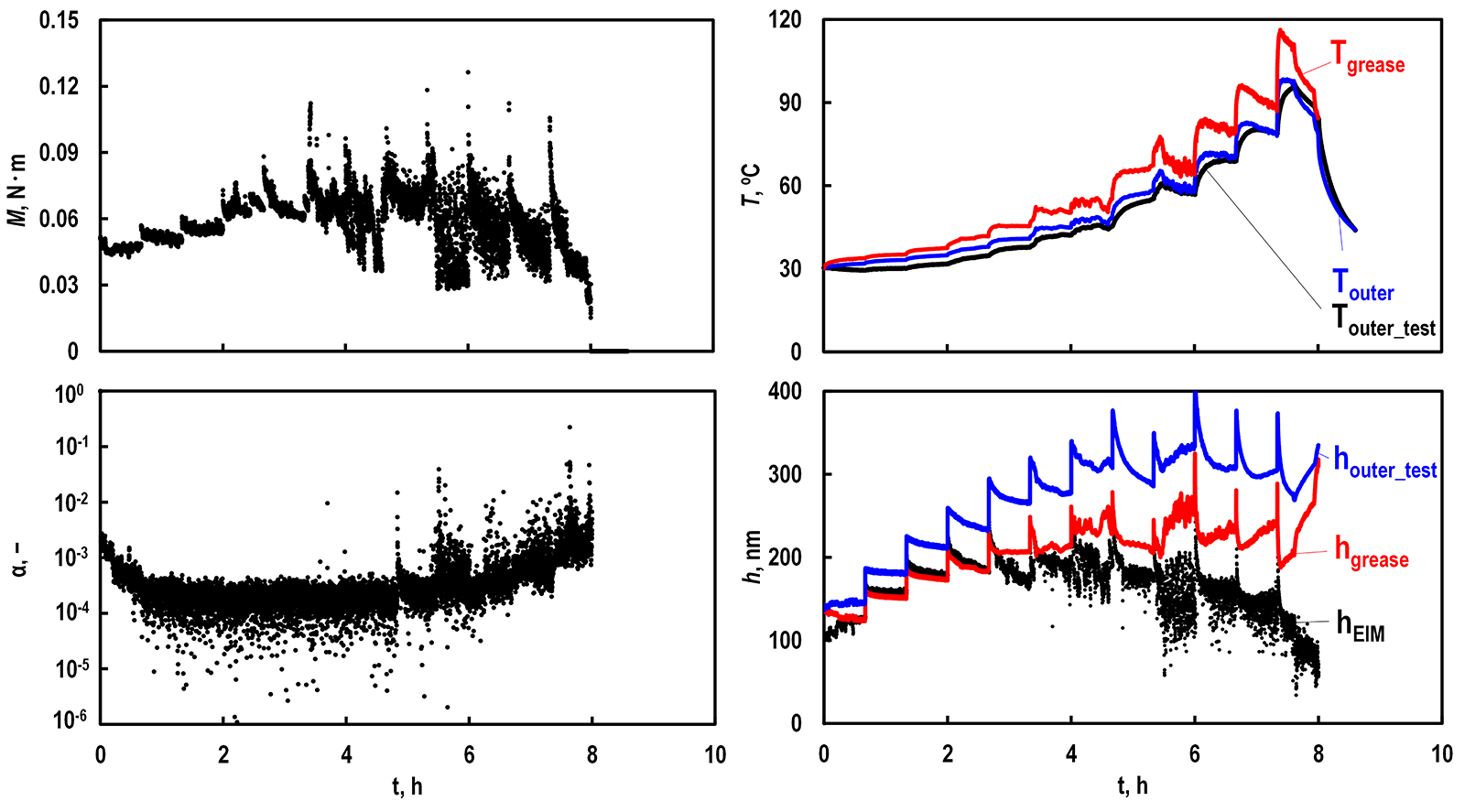
Fig.3 Calculation and Test Results
5. Discussion
The results of this study indicate that appropriate estimation of lubricant temperature is important for accurately predicting lubrication life. If the lubricant temperature is higher than the outer-ring temperature, using the outer-ring temperature as the lubricant temperature may lead to underestimation of the lubricant degradation rate and overestimation of oil-film thickness. As a result, lubrication life may be estimated to be longer than it actually is, producing a potentially non-conservative assessment.
Estimating lubricant temperature may also make it possible to distinguish changes in oil-film thickness that can be explained by the temperature-induced decrease in viscosity from changes that cannot be explained by temperature alone, such as those caused by an insufficient lubricant supply.
6. Conclusion
This study presented a method for predicting the lubricant temperature inside a bearing using the thermal network method. When the heat generation calculated from measured bearing torque and rotational speed was used as the model input, the calculated outer-ring temperature was in good agreement with the measured value. Under the test conditions used here, the estimated lubricant temperature was also found to be higher than the outer-ring temperature.
In the low- to medium-speed range, the oil-film thickness calculated using the estimated lubricant temperature was closer to the measured value than that calculated using the outer-ring temperature. In the high-speed range, however, a discrepancy from the measured value remained, indicating that the influence of lubricant starvation must be investigated.
Going forward, we will incorporate lubricant-temperature prediction, combined with the bearing-torque prediction formula, into the Lubrication Pentagon Theory and work toward establishing bearing design technology that achieves both lower torque and longer life.
References
1) NSK Technical Review No. 2603, “Lubrication Life Formula (Lubrication Pentagon Theory),” NSK website: https://www.nsk.com/tools-resources/research-and-development/technical-review/2026/lubrication-pentagon-theory/
2) Manabe K., Maeda M., Maruyama T., and Momozono S., “Contribution to Carbon Neutrality by Achieving Both Low Torque and Long Life in Rolling Bearings: Prediction of Grease Temperature Using the Thermal Network Method,” Proceedings of JAST Tribology Conference, Hakodate, A3 (2025), p.7
3) Maruyama T., Maeda M., and Nakano K., “Lubrication condition monitoring of practical ball bearings by electrical impedance method”, Tribol. Online, 14 (5) (2019) 327–338. doi:10.2474/trol.14.327:https://www.jstage.jst.go.jp/article/trol/14/5/14_327/_article