
Actuators for Robotics Applications
September 2026
Robotics Product Development Office
Robotics Business Department
Business Development Division Headquarters
1. Background and Challenges
In recent years, humanoid robots have attracted significant attention as a solution to pressing social challenges such as labor shortages and population aging. Regardless of their form factor, humanoid robots are capable of operating in the same workspaces as humans with human-like movements, making them well-suited for a wide range of applications including manufacturing, logistics, nursing care, and services. Leading global financial and investment institutions have forecasted rapid growth in this market.
Actuators installed in the joints and movable parts of humanoid robots must satisfy demanding requirements beyond the high precision and reliability traditionally required for industrial robots. The first requirement is compact size and lightweight design. Actuators that are compact and lightweight directly contribute to natural motion and energy efficiency. The second is high backdrivability — the ability of an actuator to passively comply with externally applied forces — which is essential for ensuring safety in tasks involving physical contact with humans. The third is mechatronic integration: integrating the motor, driver, and sensors into a single unit simultaneously simplifies wiring and enhances design flexibility.
NSK has built a strong track record supplying bearings, ball screws, and other products for industrial robots. Building on these core technologies, NSK undertook the development of actuators that satisfy all three of the above requirements simultaneously.
2. Overview of Developed Products
NSK has developed two products: a rotary actuator and a linear actuator (Fig.1). These products were developed in collaboration with Delta Electronics, Inc., a global leader in power supply, control, and automation solutions. NSK was responsible for the mechanical design integrating bearings, ball screws, and a speed reducer, while Delta Electronics was responsible for the frameless motor, encoder, motor controller, and software platform. By combining the strengths of both companies, the products achieve a level of compactness and performance that would be difficult to attain through individual procurement.
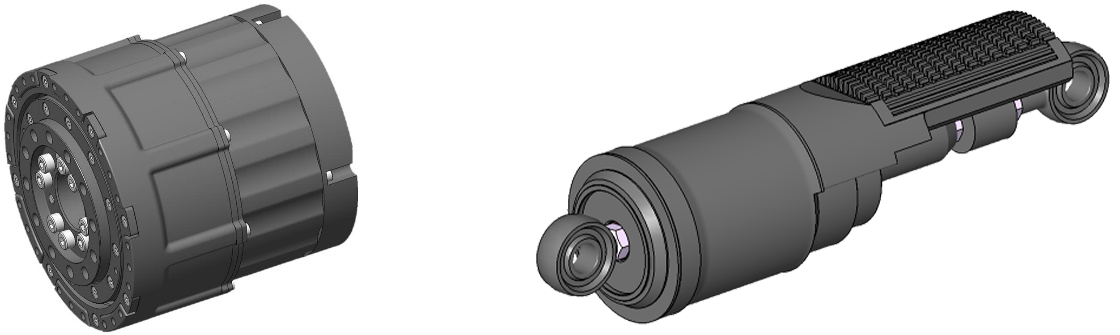
Fig. 1 Rotary Actuator (left) and Linear Actuator (right)
2.1 Rotary Actuator
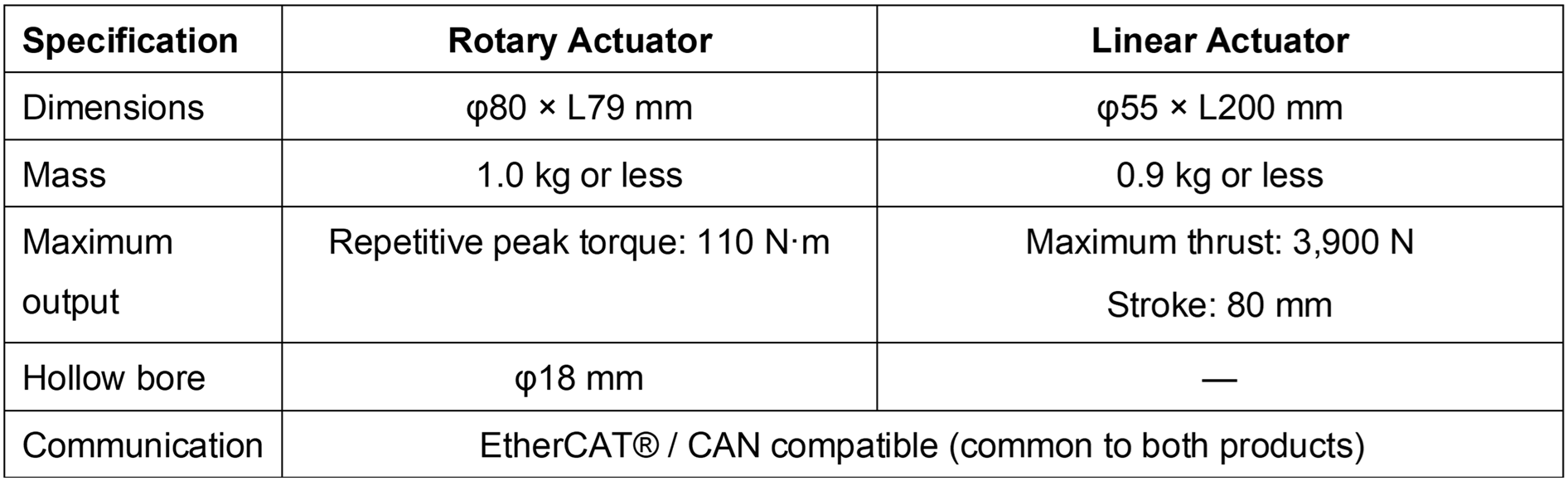
The rotary actuator is designed primarily for use in joint sections of humanoid robots. By employing NSK's proprietary high-performance bearings, the actuator achieves a repetitive peak torque of 110 N·m and a torque-to-weight ratio of approximately 110 N·m/kg within a compact envelope of φ80 × L79 mm and a mass of 1.0 kg or less. A hollow bore of φ18 mm allows cables and piping to be routed through the interior of the joint, contributing to greater flexibility in robot wiring layout design. In addition, backdrivability is improved through load torque estimation.
2.2 Linear Actuator
The linear actuator is designed for linear motion sections of robots. It employs a high-load ball screw with excellent reverse-drive characteristics. Ball screws offer low friction losses and highly efficient power transmission, enabling high backdrivability. The adoption of a high-density, high-heat-dissipation layout results in a compact and lightweight structure measuring φ55 × L200 mm with a mass of 0.9 kg or less, while achieving a maximum thrust of 3,900 N and a maximum thrust-to-weight ratio of approximately 4,300 N/kg.
2.3 Common Specifications
Both products feature a mechatronic integrated structure incorporating Delta Electronics' high-efficiency motor controller (conversion efficiency of 97% or more). Both also include a high-speed communication interface compatible with EtherCAT®* / CAN, supporting real-time control of the entire robot system. Key specifications are shown in Table 1.
*EtherCAT® is a registered trademark and patented technology of Beckhoff Automation GmbH, Germany.
Table 1 Key Specifications of Developed Products
3. Benefits
The introduction of these products is expected to deliver the following benefits for humanoid robots. The compact and lightweight design expands the freedom of joint and structural design, contributing to the realization of robots with natural motion characteristics. In addition, the high-efficiency power transmission of NSK's bearings and ball screws reduces power consumption, while the reduction in overall robot weight contributes to extended battery-powered operation.
4. Future Outlook
In addition to the currently developed medium-sized models (rotary: 110 N·m, linear: 3,900 N), NSK plans to gradually expand its lineup with smaller and larger variants. NSK will aim to provide solutions that allow robot designers to design flexibly while ensuring optimal placement of these components in various parts of the robot.
NSK will progressively offer sample products for joint evaluation and prototype testing with customers, with a target market launch in 2028. In parallel, NSK will also expand its lineup of bearings and ball screws for use in actuators, contributing to the development of the robotics market through both system-level provision and component supply.