

Materiality
In 2024, the NSK Group identified the material topics it should work on as priorities in the sustainability area. We recently conducted a further review of materiality as part of the process of formulating our Mid-Term Management Plan 2028 (MTP2028).
Material Topic Identification Process
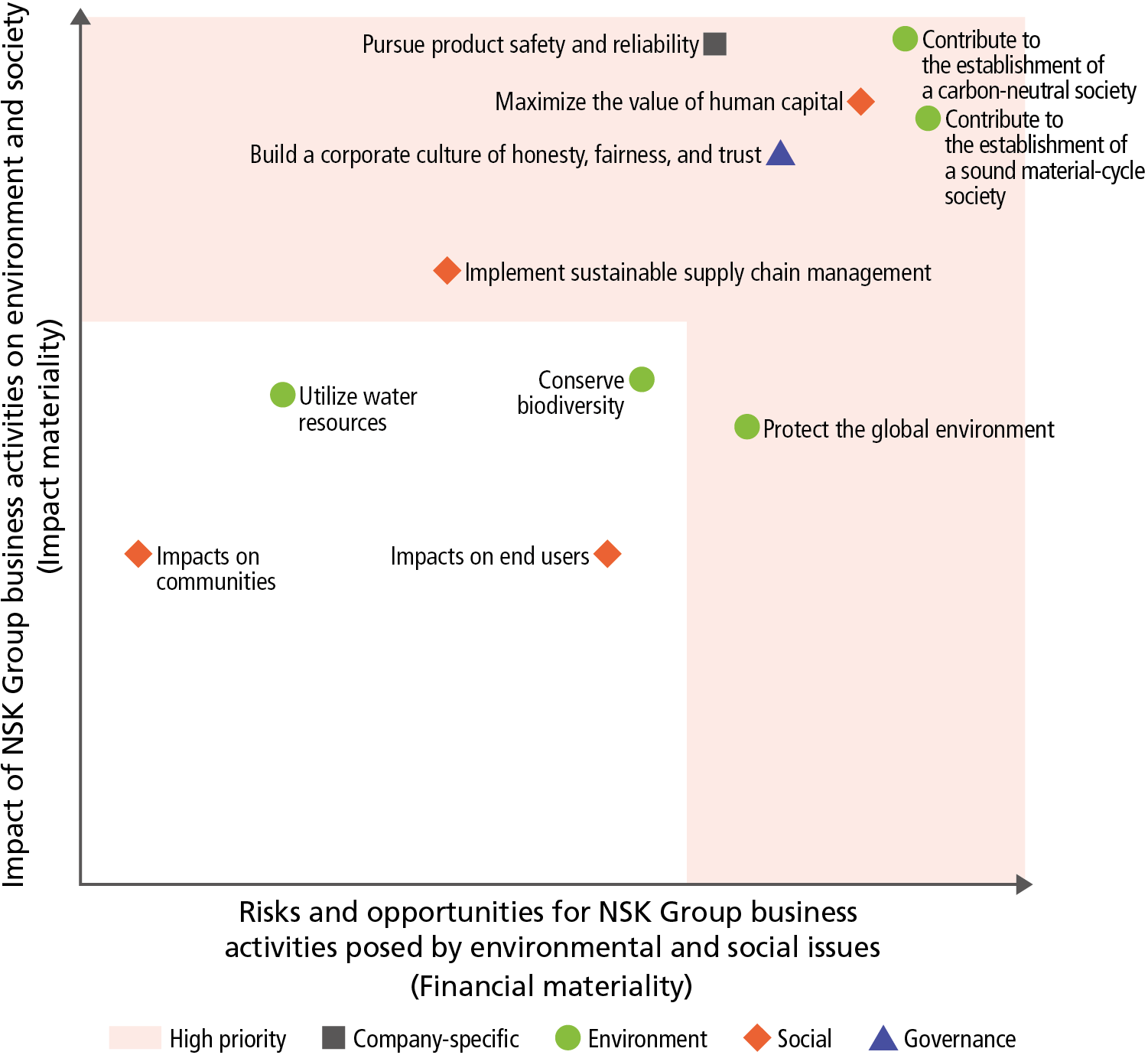
The NSK Group has identified seven material topics based on the concept of double materiality.*
*Double materiality: A method of assessing material topics by evaluating not only the impact of changes in the external environment such as social issues on business, but also the impact of a company’s activities on external stakeholders, the environment, and society.
Step 1: Selection of Subjects for Material Topic Assessment
Based on the environment surrounding the NSK Group and changes in the trends around sustainability-related regulations, we advanced discussions with various departments involved in sustainability about the impacts, risks, and opportunities that will or could affect our contribution to solving social issues and NSK’s sustainable growth from both short- and mid- to long-term perspectives and selected 88 topics as assessment subjects in materiality analysis. In making the selection, we considered factors including sustainability standards (SDGs, GRI Standards, SASB Standards, and ESRS) and questionnaires from ESG research organizations, as well as ongoing engagement with stakeholders.
Step 2: Assessment and Analysis of Material Topic Candidates
We assessed and mapped the importance of the assessment subjects in terms of “the impact of the NSK Group’s business activities on the environment and society” (impact materiality) and “the impact of risks and opportunities created by environmental and social issues on the NSK Group’s business activities” (financial materiality) from both positive and negative perspectives. Using this process, we identified 34 important impacts, risks, and opportunities. We consolidated those that were highly inter-related into 11 subjects (see the diagram below), which we further narrowed to 7 material topic candidates.
Step 3: Identification of Material Topics
The candidate material topics were deliberated by the Operating Committee, which consists of representatives from the executive divisions. The CEO then made the final determination on the material topics. They were then shared throughout the NSK Group via the Officers’ Meeting and reported to the Board of Directors. Material topics will be revised annually based on NSK’s management situation, changes in social conditions, changes in stakeholder requests, and other factors.
*The appropriateness of the setting and analysis content of the above identification process has been assessed with insights from an external consultant.
◆Seven Material Topics
The newly identified material topics are linked to MTP2028 based on the Corporate Philosophy, the core values, and NSK Vision 2036.

◆Identified Material Topics
| Materiality | Reasons for selection (impacts, risks, opportunities) | Mid-term KPIs | Targets (FY2028 when not specified) | FY2025 achievements |
|---|---|---|---|---|
| Pursue product safety and reliability | ● Possibility that quality issues could negatively impact customer and end user trust, as well as society's sense of security ● Contributing to a safer, smoother society through high-quality products and services ● Enhancing brand value and gaining growth opportunities by improving quality | ■ Number of serious quality incidents ■ Number of participants in Quality-Dojo training | ■ 0 ■ Implementation rate at global production sites and technical departments: 100% | ■ 0 ■ Achieved at least 100% |
| Contribute to the establishment of a carbon-neutral society | ● Possibility that the Company’s business activities and procurement of parts, as well as use of its products, etc. will impact climate change by CO2 emissions ● Possibility of increase in development costs and capital investment to achieve decarbonization, as well as increase in costs due to introduction of carbon pricing ● Possibility of loss of credibility and exclusion from procurement panels due to standstill in decarbonization initiatives ● Possibility of need for business portfolio adjustment due to advancement in decarbonization measures for automobiles ● Contributing to optimization of society's energy use and decarbonization through products and technologies with high performance and reliability | ■ CO2 emission reductions ■ Number of environmentally friendly products created | ■ ・FY2035 achieve carbon neutrality for Scope 1 + 2 ・Reduce Scope 1 + 2 emissions by 61% or more compared to FY2017*1 ■ Create environmentally friendly products with an NSK Eco-efficiency Indicator (Neco)*2 score of 1.2 or more | ■ Compared to FY2017 ■ Number created: 0 |
| Protect the global environment | ● Possibility of loss of public trust due to soil and groundwater contamination, and the resulting costs of pollution remediation | ■ Number of serious soil contamination incidents ■ Completion of efforts to prevent oil leaks from oil tanks and piping | ■ 0 ■ Global 100% | ■ 0 ■ 27% |
| Contribute to the establishment of a sound material-cycle society | ● Possibility of insufficient progress in effective utilization of resources and delays in reducing environmental impact ● Supporting resource circulation in industry through greater resource efficiency and measures for recycling and reuse based on PLM | ■ Increase in use of recycled materials ■ Expansion of initiatives related to resource circulation (greater resource efficiency, recycling and reuse based on PLM, etc.) | ■ Percentage of recycled steel (electric arc furnace materials): ■ Manage progress of measures for time being toward goal of setting quantitative indicators | ■ Global 49% Japan 81% ■ Began verification of bearing recycling and reuse using original diagnostic technology |
| Maximize the value of human capital | ● Possibility of increase in employment costs due to changes in the external environment (low birthrate, aging population, inflation, etc.) ● Possibility of fatalities and serious workplace accidents having a severe impact on employees, possibly resulting in compensation, remediation costs, and loss of reputation ● Increasing the motivation of employees and supporting their career development through education and training ● Strengthening competitiveness and enhancing corporate value by promoting DE&I and improving the skills of employees ● Developing a safe and secure workplace | ■ Percentage of employee diversity (women employees, mid-career hires, and non-Japanese employees [Japan]*3) ■ Engagement score ■ Percentage of local employees in global posts ■ Annual study hours per person [Japan]*3 ■ Rate of lost worktime accidents | ■ 35% or more ■ 75% or more (global) ■ Maintain at 75% or more ■ 50 hours/year ■ 0.10 or less | ■ 30% ■ 74% ■ 76% ■ 21 hours ■ 0.14 |
| Implement sustainable supply chain management | ● Possibility of negative impacts due to lack of safety and health among suppliers and occurrence of workplace accidents | ■ Supplier CSR self-assessment | ■ Maintain and improve scores | ■ Supplier CSR self-assessment is conducted every other year with next survey scheduled for FY2026 |
| Build a corporate culture of honesty, fairness, and trust | ● Possibility of fines/litigation costs and loss of reputation due to legal violations ● Developing a corporate culture with awareness of the environment and society and strong compliance awareness through alignment with the Corporate Philosophy | ■ Increase in awareness of whistleblower system ■ Increase in compliance category score on awareness survey ■ Number of serious compliance incidents | ■ Global awareness: 95% ■ 75% or more ■ 0 | ■ 93% ■ 78% ■ 0 |
*1 Full year, includes steering business
*2 Neco (NSK Eco-efficiency Indicators): NSK's unique metric to quantitatively evaluate the environmental contribution of products. It evaluates degree of improvement in the two factors of product value and environmental impact with conventional products having a reference value of 1.
*3 Applies to NSK Ltd.