
Highly Reliable Spherical Roller Bearings for Wind Turbine Main Shafts
March 2026
Roller Bearing Technology Office 2
Roller Bearing Technology Department
Industrial Machinery Technology Development Center
1. Introduction
In recent years, there has been a trend toward increasing awareness of global environmental conservation, and the expectations for wind power generation as a renewable energy source are increasing. While the wind turbine is designed for 20 years of operation, there are several technological trends to improve power generation efficiency, such as larger units and offshore deployment. As a result, the complexity and cost of part replacement during maintenance have become an issue. Consequently, high-reliability is required for the bearings installed in wind turbines1).
The bearings for wind turbine main shaft support external loads from wind forces and the weight of the blades and drive train (Fig.1). Therefore, the spherical roller bearings, which have higher load capacity and greater tolerance for mounting errors compared to other bearing types, have been used for wind turbine main shaft applications. However, the surface damage such as wear and peeling has been confirmed as the main failure mode in spherical roller bearings for wind turbine main shaft. Therefore, countermeasures are necessary to reduce down-time associated with component replacement.
This time, NSK has developed and launched a high-reliability spherical roller bearing for wind turbine main shaft, offering high load capacity and excellent resistance to surface damage (Fig.2)1).
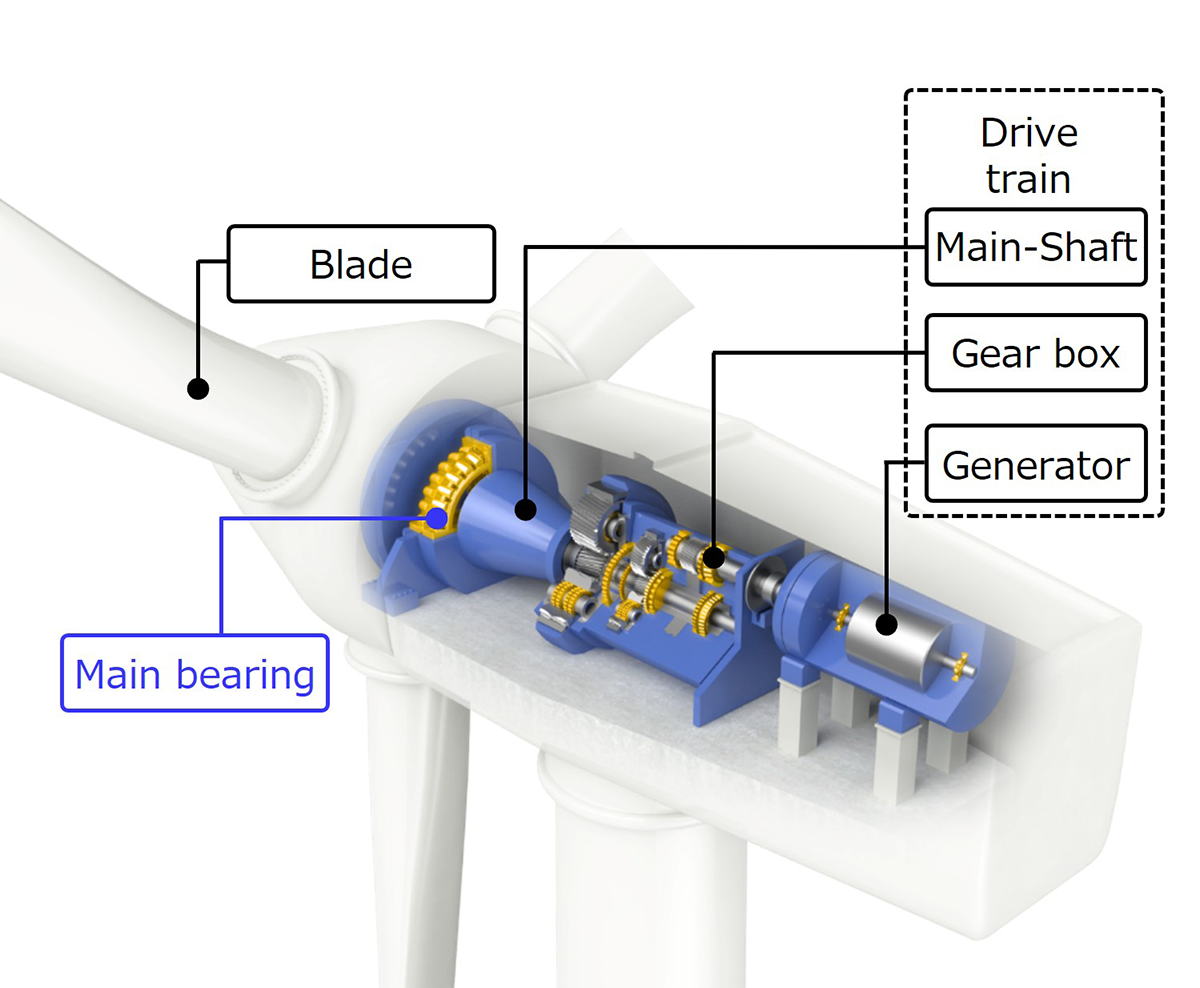
Fig.1 Primary structure of wind turbine drive train
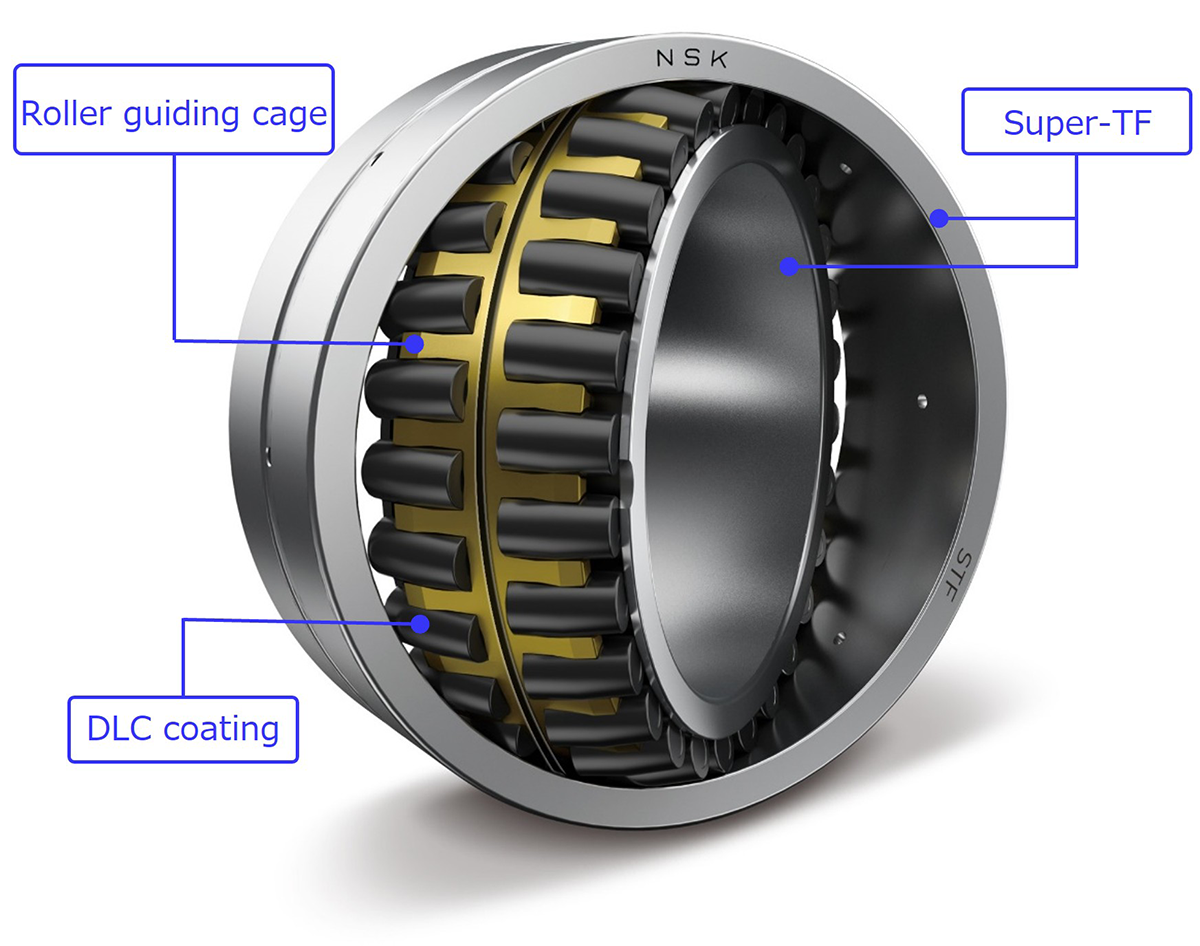
Fig.2 High-reliability spherical roller bearings for wind turbine main shaft (development product)
2. Usage and challenges for spherical roller bearings for wind turbine main shaft
The bearings for wind turbine main shaft must support fluctuating loads caused by wind and the weight of the blades and drive train. Since large radial and axial loads are applied, a very high load capacity is required.
At the same time, they are used at very low rotational speeds of around 10 to 20 min-1. Therefore, it is anticipated that sufficient oil film formation is difficult to achieve in bearings for wind turbine main shaft. Furthermore, a major challenge with the spherical roller bearing is that the inherent structure allows sliding between the rolling elements and the ring raceway surfaces, which can lead to rapid deterioration of surface performance caused by metal-to-metal contact. As a result, a major issue is that it is prone to surface damage such as wear and peeling2).
3. Technical Overview of the Developed Product
3.1 High Load Capacity
This newly development product uses an ECA-type cage with a special pocket shape that eliminates the need for a guide ring. Conventionally, the standard spherical roller bearings (CA-type, Fig.3) featured guide rings to guide the cage, the newly developed spherical roller bearings (ECA-type, Fig.4) do not have these guide rings. This eliminates sliding between the guide ring and the cage, reducing the generation of wear metallic particle. In addition, by optimizing the shape of the cage, the cage pillars have been made thinner while improving cage strength. Consequently, the internal design of the bearing has been revised, with the size and number of rolling elements increased, resulting in higher load capacity and lower contact pressure1).
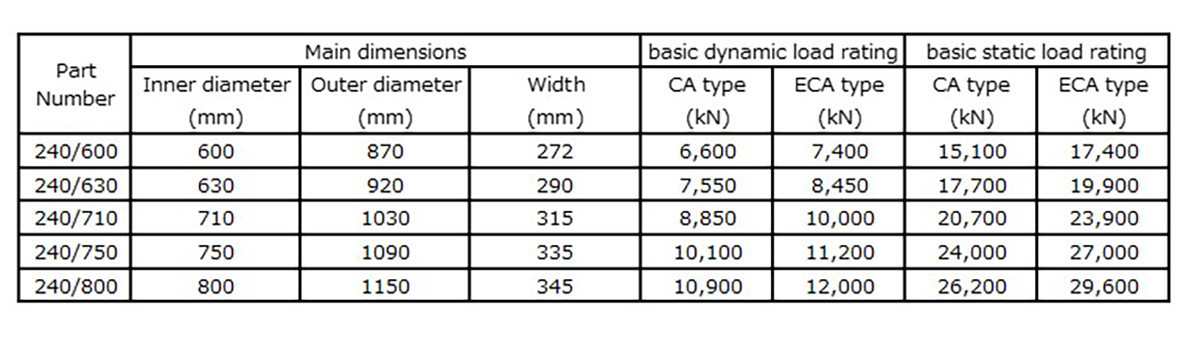
As the results, the load capacity is 1.1 times greater than that of conventional CA-type cages, and the bearing life is 1.3 times longer (Table 1).
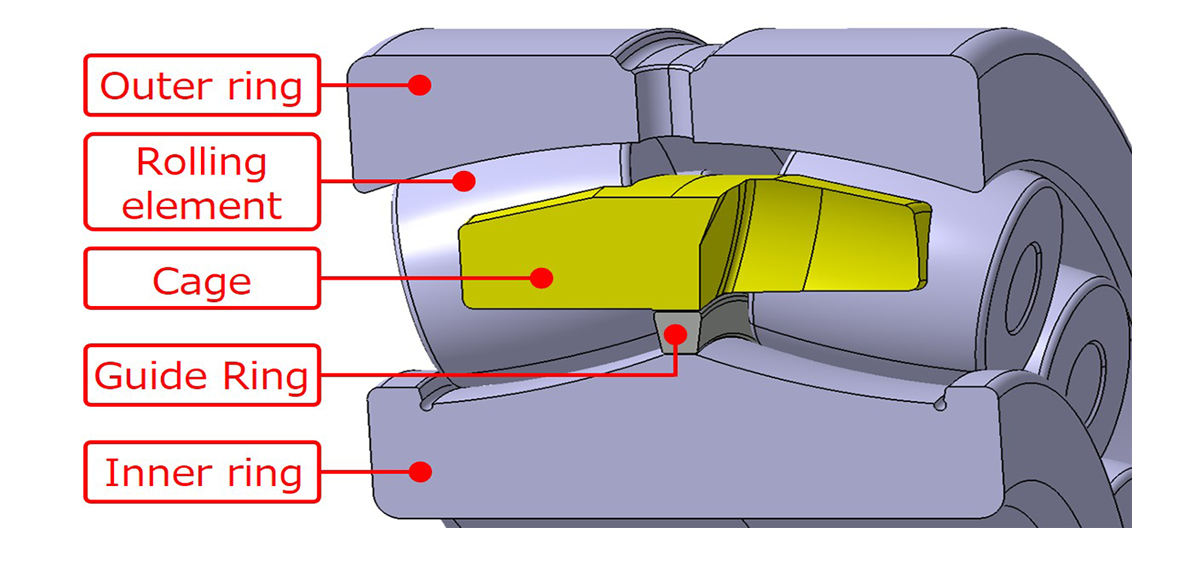
Fig.3 Conventional Product: spherical roller bearings (CA-type)
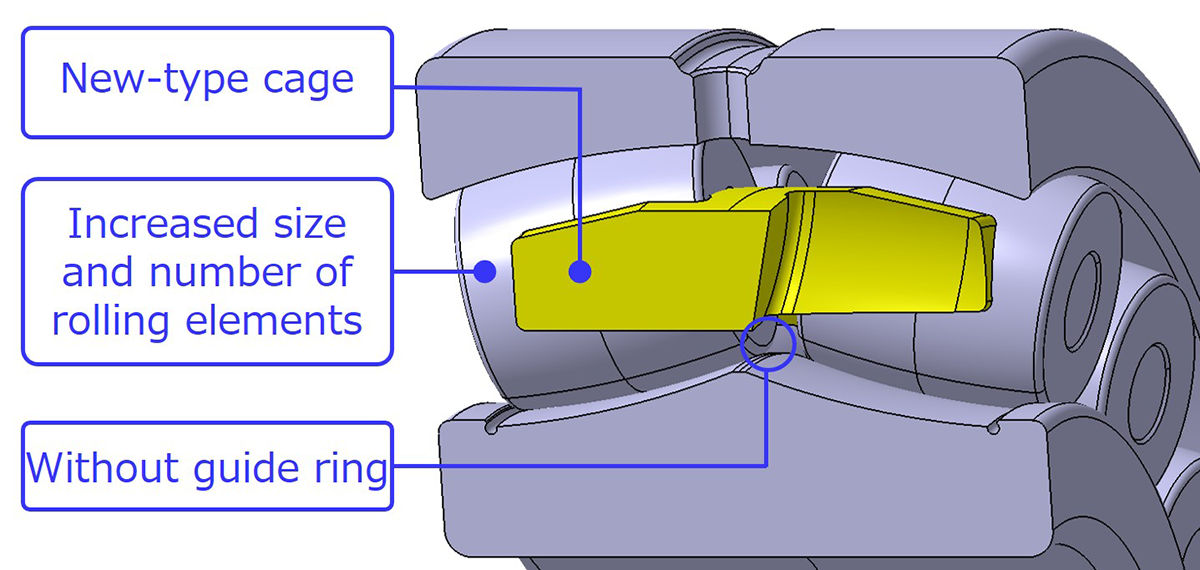
Fig.4 Newly Developed Product: spherical roller bearings (ECA-type)
Table 1 Load capacity (major part numbers for wind turbine main shafts)
3.2 Wear resistance
3.2.1 Material and Heat Treatment Technology
It is known that surface damage originates from indentations caused by foreign matter in environments where contaminants such as wear metallic particles are generated. NSK developed technology to reduce stress concentration caused by indentations when foreign matter was present by optimizing the amount of retained austenite. Furthermore, based on this technology, NSK's unique material and heat treatment technology (Super-TF™) was developed, which increases the total amount of retained austenite while improving surface hardness by adding an appropriate amount of carbide-forming elements (chromium, molybdenum) to steel and then subjecting it to special heat treatment3). By applying this technology to the inner and outer rings of this newly developed product, they have achieved improved wear resistance of the raceway surfaces compared to standard-bearing-steel bearings (Fig.5).
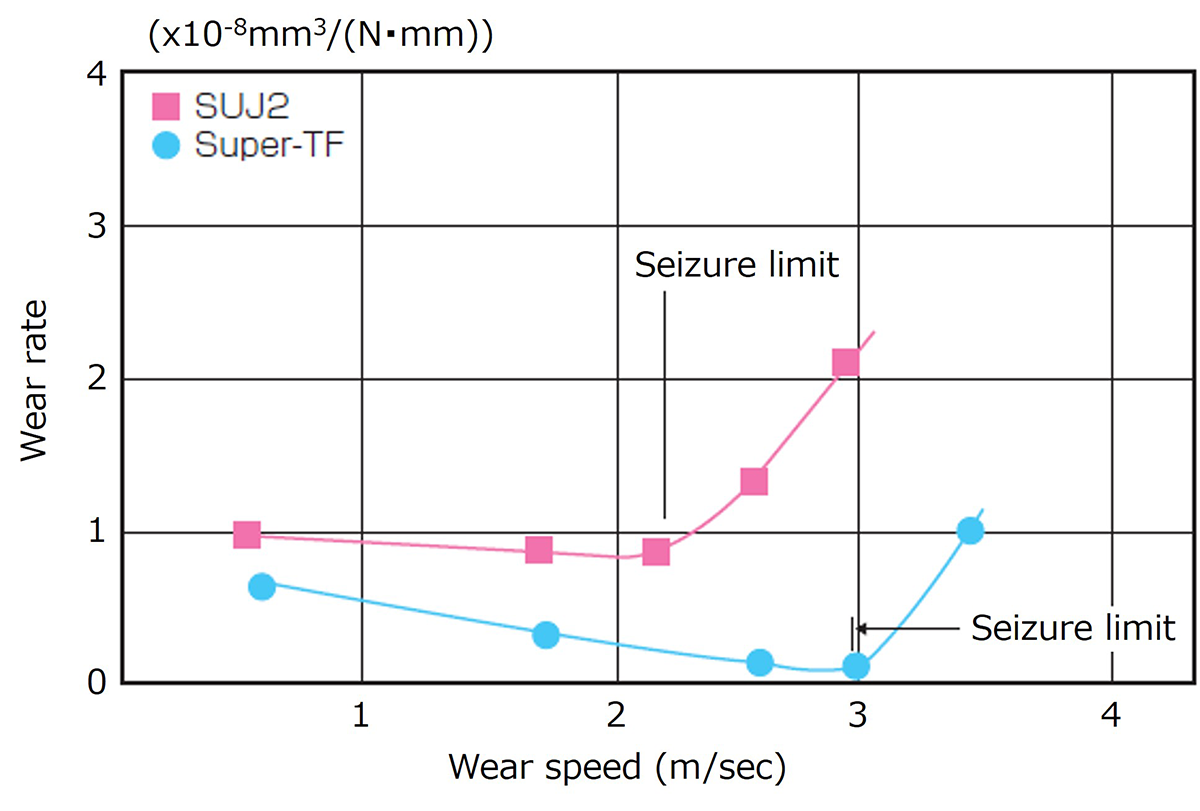
Fig.5 Comparison of wear resistance characteristics(Sawin-type wear test)
3.2.2 Coating Technology
The rolling elements are coated with a high-hardness DLC (Diamond-Like-Carbon) coating several micrometers thick. In this developed product specification, a special layered structure achieves both adhesion to the base material and coating hardness, thereby improving coating durability (Fig.6). The DLC coating prevents surface deterioration caused by metal contact between the rolling elements and raceway surfaces when oil film formation is insufficient. This also contributes to reducing the increase in tangential force between the rolling elements and the raceway surface. Consequently, surface wear on the raceways will be reduced to less than one-tenth compared to standard un-coated products (Fig.7).
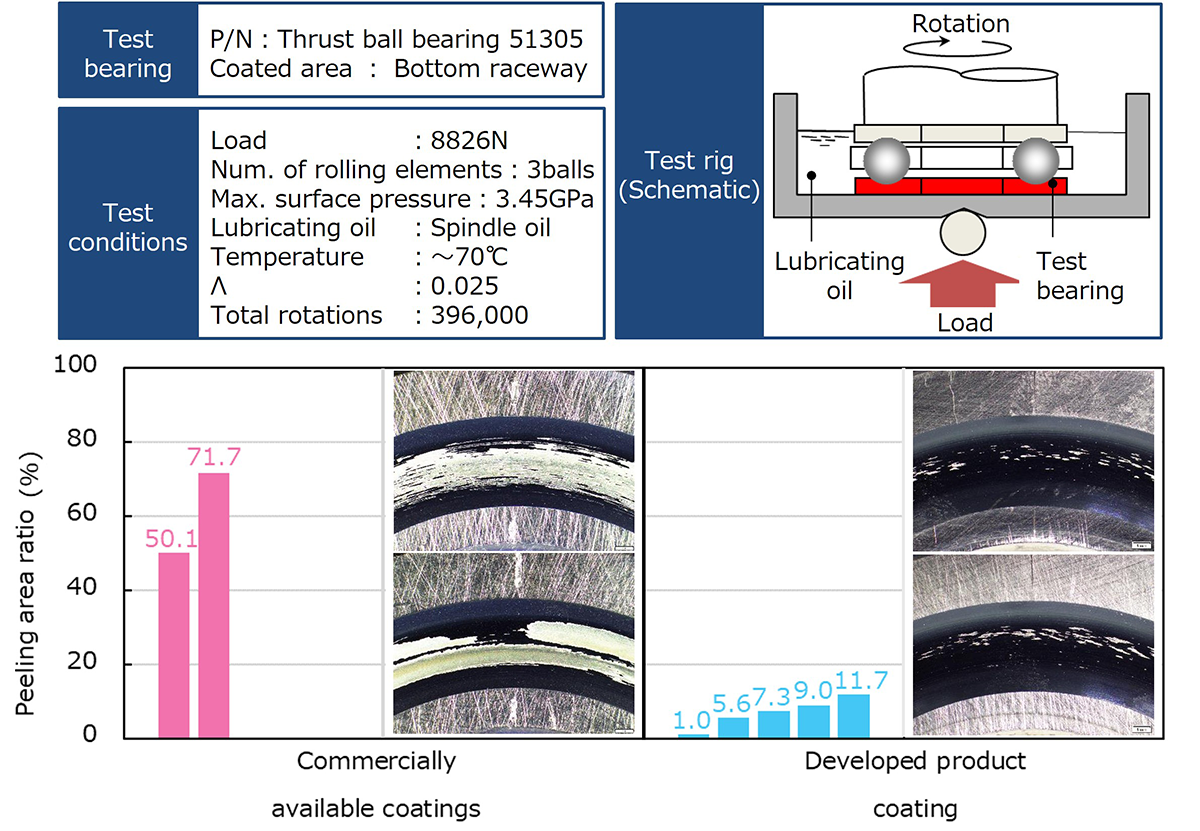
Fig.6 Coating peel test results
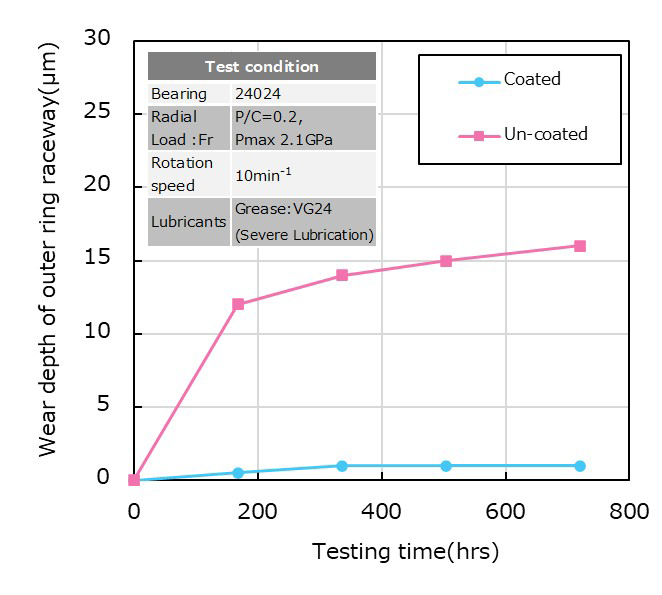
Fig.7 Wear depth test results for outer ring raceway surface
4. Conclusion
NSK has developed the spherical roller bearing for wind turbine main shaft that offers high-reliability and durability even under low rotational speed and high load conditions. This was achieved by revising the internal bearing design with a new cage type and applying material, heat treatment, and coating technologies.
A key feature of this new product is that it achieves approximately 1.3 times the bearing life of conventional standard products while reducing wear to less than one-tenth.
Sales of this product began in June 2024 for wind turbines in North America. NSK will continue to expand our business, primarily in the aftermarket, contributing to the stable operation of wind turbines as they become larger and move offshore.
References
1) NSK Ltd., “Highly reliable bearings for wind turbine main shaft”, NSK TECHNICAL JOURNAL, No. 697, (2025) 80–81.
2) NSK Ltd., “ADVANCED BEARING SOLUTIONS FOR THE WIND INDUSTRY”, NSK catalog, CAT. No.E1285a, (2025) 7–11.
3) NSK Ltd., “ROLLING BEARINGS for INDUSTRIAL MACHINERY”, NSK catalog, CAT. No.E1103d, (2025) A258-A261.