

NSK Ltd.
Corporate Communications Department
NSK Publishes Japanese Bearing Industry’s First Carbon Footprint of Products (CFP) Assessment for Reconditionable Large-Size Tapered Roller Bearings with High Load Capacity
NSK Ltd. (NSK; Headquarters: Tokyo; President & CEO: Akitoshi Ichii) has published a CFP Assessment Report summarizing the company’s self-assessed carbon footprint of products for its reconditionable large-size tapered roller bearings developed for mining equipment. NSK published the report as part of its efforts to help build a decarbonized society. This is the first CFP assessment report for a reconditionable bearing to be published in the Japanese bearing industry*1.
*1Per July 2025 survey of industry bearing makers conducted by NSK
1. Background and Importance of CFP Disclosure
CFP is a quantitative indicator that shows greenhouse gas emissions per product. With the global push toward a decarbonized society, policies focusing on CFP are being promoted worldwide. In Japan as well, interest in CFP disclosure is growing, as evidenced by the Ministry of the Environment’s publication Guide to Carbon Footprint Indications in February 2025. CFP is calculated based on CO2 emissions throughout the entire product lifecycle; however, since values vary depending on calculation conditions, the transparent disclosure of such information is essential.
2. NSK’s CFP Assessment Report Initiatives
NSK has been working to reduce maintenance costs and CO₂ emissions for mining equipment, and in March 2025, the company developed the industry’s first*² high-load capacity large-size tapered roller bearing designed for easy disassembly and reconditioning (reuse through restoration).
This CFP Assessment Report aims to clearly communicate the calculation metrics for CO₂ emissions across the entire lifecycle of this product.
*2For tapered roller bearings for mining equipment per a Feb. 2025 survey conducted by NSK
3. Contents of the CFP Assessment Report
The published CFP assessment report is disclosed in accordance with the “Basic Principles for Indicating CFP” in the Guide to Carbon Footprint Indications released by Japan’s Ministry of the Environment and covers the following:
- Purpose of the assessment
- Assessed product and functional unit
- Target greenhouse gas emissions/lifecycle
- Cutoff criteria and scenarios
- Information regarding data used
- Referenced rules
- Calculation results
- Limitations and planned updates
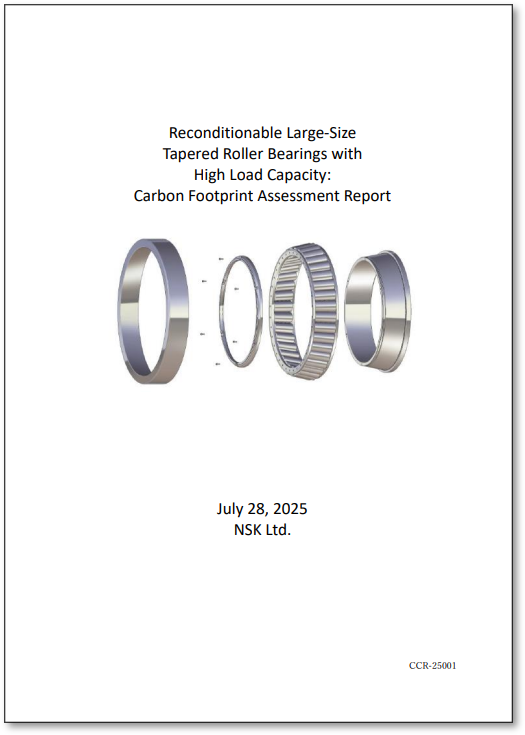
Reconditionable Large-Size Tapered Roller Bearings with High Load Capacity: Carbon Footprint Assessment Report
■ For more details, please see the relevant pages below.
◆ Product Information:
◆ CFP Assessment Report:
・Reconditionable Large-Size Tapered Roller Bearings with High Load Capacity
4. Future Initiatives
NSK aims to achieve carbon neutrality by fiscal year 2035 by reducing Scope 1 and Scope 2 CO₂ emissions to net-zero. To this end, NSK continues to leverage its tribology and manufacturing technologies to reduce fuel and electricity consumption, pursue energy-saving initiatives and technological innovation, and utilize renewable energy to cut CO₂ emissions in the production stage.
Furthermore, NSK works to reduce CO₂ emissions across the entire product lifecycle by developing and adopting environmentally friendly materials, implementing eco-friendly logistics, and clarifying the environmental impacts of product use and disposal by customers.
NSK is committed to the realization of a carbon-neutral society through expanded sales of environmentally friendly products. In addition, the company will continue to ensure the transparency and accuracy of product CO₂ emissions by the regular release of CFP Assessment Reports.
About NSK
NSK produced the first bearings in Japan in 1916 and over the past 100 years, it has supported the development of industries worldwide by creating various innovative products and technologies in bearings, automotive parts, and precision machinery. Since the early 1960s, the company has expanded overseas and now has operations in about 30 countries. It ranks third in the world in the field of bearings and leads the world in ball screws, electric power steering, and other products.