
BEFORE DESIGN FREEZE. WHILE THE DESIGN CAN STILL CHANGE.
Precision bearings, ball screws and actuator sub-systems —and an NSK application engineer who works the problem with your team — analyze the whole application — and recommends a solution while a change is still a drawing revision.
TALK TO AN ENGINEERNot Just a Part Supplier. An Engineering Partner.
Most designs don’t need a custom part. They need an engineer who knows the application well enough to pick the right one.
Usually, What We Already Make
Most problems end here: the right existing product, applied to your condition properly. It is also your fastest and cheapest route — proven, available, second-sourceable.
Adapted Where It Counts
Where an existing design is close, we change what needs changing — clearance, cage, seal, lubricant, material — and leave the rest proven.
A design program, where it is warranted
A small number need one. Whether it's the right thing to do is something we work out with you.

Bearings
From ¼″ × ¼″ thin-section and bores under 10 mm, up to bearings measured in metres.
Ball screws
C0 to C7 accuracy, miniature to ultra-large. Ground in Franklin, Indiana.
Actuators & sub-systems
Screw, guide and bearings built and tested as one unit. One part number instead of five.
Bearings
From ¼″ × ¼″ thin-section and bores under 10 mm, up to bearings measured in metres.
Ball screws AND LINEAR GUIDES
C0 to C7 accuracy, miniature to ultra-large. Ground in Franklin, Indiana.
Actuators & sub-systems
Screw, guide and bearings built and tested as one unit. One part number instead of five.
Why Now
The fix gets expensive on a schedule.
A catalogue rating is calculated without your duty cycle, your clearance, your lubricant or the parts around it. If that assumption is wrong, what it costs you depends on when you find out.
DESIGN FREEZE HTML COMPONENT
What you get
Four Things You Leave With.
Send the problem. An engineer works it and comes back with something you can act on — so the next design review moves instead of waiting.
Webinar - Date TBD
How our engineers work inside your design.
One hour, one worked example, start to finish. How a requirement becomes a specification, what the model shows, and where the trade-offs actually sit.
Can't make it? We'll send the recording.
SPEAKER

Name to Confirm
Simulation Engineer
Ten years modeling how bearings behave inside a customer's machine — stiffness, friction, heat and life, under the real duty cycle rather than the catalog one.
He'll walk through how NSK works inside a customer's system as it is being developed, and run the simulation live so you can see what the model actually tells you.
Where we do this
Pick the One You're Building.
Send the problem. An engineer works it and comes back with something you can act on — so the next design review moves instead of waiting.
- Humanoid Robotics
- Advanced Air Mobility
- Space
- Medical Devices
Every requirement in the joint fights another one.
Impact loads every step. Stiffness for accuracy against compliance for safety. Lower reduction buys back-drivability, higher buys power density.
What We Size Against
Impact and moment load at the joint
Stiffness and friction across dozens of actuators
Mass and envelope, paid for at every joint above
Whether it can be built at rate
Every gram you save comes back four times.
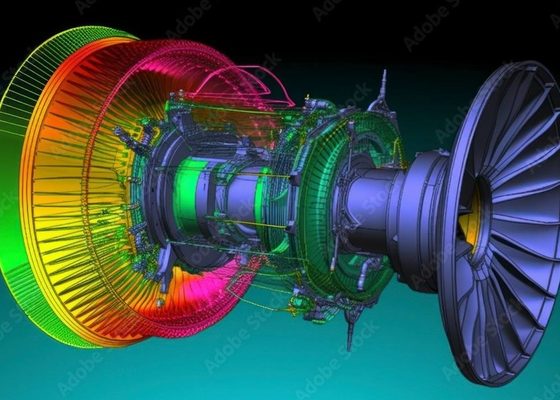
Less mass needs less lift, less lift needs less power, less power needs less battery — which is less mass again. A milligram of drag in a propulsion bearing is not a component number, it is range. And none of it counts unless the part holds for the whole certified life, because an aircraft cannot pull over.
What We Size Against
Friction and heat in propulsion motors running at extreme speed
Rotor assemblies holding precision and durability over millions of cycles
Tilt mechanisms that must behave the same on the last transition as the first
Certification requirements, which are different on every platform
Some parts only get one chance to work.
A reaction wheel, a deployment hinge that operates once, a cryogenic pump. Nobody services any of them. And some of these conditions cannot be fully reproduced in a lab, which means part of the answer is experience rather than a test result.
What We Size Against
Vacuum, where conventional lubrication stops working
Temperature from extreme heat down to cryogenic
Mechanisms that actuate once, and must
Friction and precision holding across years of operation
It has to hold precision for the life of the device.
A surgical arm, an imaging gantry, a liquid handler. The motion has to stay accurate across the full duty cycle, survive an environment nobody is going to service, and be defensible in a design review.
What We Size Against
Repeatability at the end effector under real load
Smooth, quiet, backlash-free motion of heavy masses
High cycle counts, unattended and maintenance-free
An accuracy grade you can defend, not just quote

Worked example · robotic joint actuator
The bearing was right. The grease wasn't.
A customer specified a bearing for a robotic joint actuator, and the datasheet confirmed the selection was correct. We modelled the joint rather than the bearing on its own — both bearings, shaft and housing bending, load distribution, clearance and lubrication. At the real operating condition the oil film was too thin for the duty cycle. The bearing was not the problem. The grease was.
No new part. The bearing we already made was the right one — the change was the grease, specified while the design was still open.
What Changed
The grease. Not the bearing.
How It Works.
Send the problem
Loads, speed, duty cycle, envelope, environment.
An engineer picks it up
A named application engineer picks it up. Before any work starts you agree together what it needs to be — and how long that will take.
You get something to act on
Configurations, trade-offs, the calculation behind them, the CAD.
Send the problem
Loads, speed, duty cycle, envelope, environment.
An engineer picks it up
A named application engineer picks it up. Before any work starts you agree together what it needs to be — and how long that will take.
You get something to act on
Configurations, trade-offs, the calculation behind them, the CAD.
Send the problem
Loads, speed, duty cycle, envelope, environment.
An engineer picks it up
A named application engineer picks it up. Before any work starts you agree together what it needs to be — and how long that will take.
You get something to act on
Configurations, trade-offs, the calculation behind them, the CAD.
Send the problem
Loads, speed, duty cycle, envelope, environment.
An engineer picks it up
A named application engineer picks it up. Before any work starts you agree together what it needs to be — and how long that will take.
You get something to act on
Configurations, trade-offs, the calculation behind them, the CAD.
Send the problem
Loads, speed, duty cycle, envelope, environment.
An engineer picks it up
A named application engineer picks it up. Before any work starts you agree together what it needs to be — and how long that will take.
You get something to act on
Configurations, trade-offs, the calculation behind them, the CAD.

And after design freeze
The support doesn't stop at the drawing.
Longer life when conditions aren't ideal
Most bearings don't fail from load. They fail because the lubricant picks up contamination, or the oil film runs thin and the surfaces touch.
We make bearing steels developed for exactly those conditions — Hi-TF and Super-TF — so life holds up when the machine doesn't run the way the calculation assumed.
When something fails, you find out why
Send us the part. The marks on a raceway say whether it was contamination, misalignment, electrical current or lubrication.
Our lab in Ann Arbor reads them and gives you the cause — so the fix is permanent, not another part that fails the same way.
Tell us what the machine has to do.
A named application engineer picks it up and comes back with what the work involves. If a standard product solves it, we'll tell you that too — and if it isn't a bearing problem at all, we'll say so.
---------------------FORM HERE---------------------
Share